

While the sector’s recent trajectory was significantly altered by substantial downward revisions to improvement (remodeling) spending, private residential construction spending declined 0.3% in June.
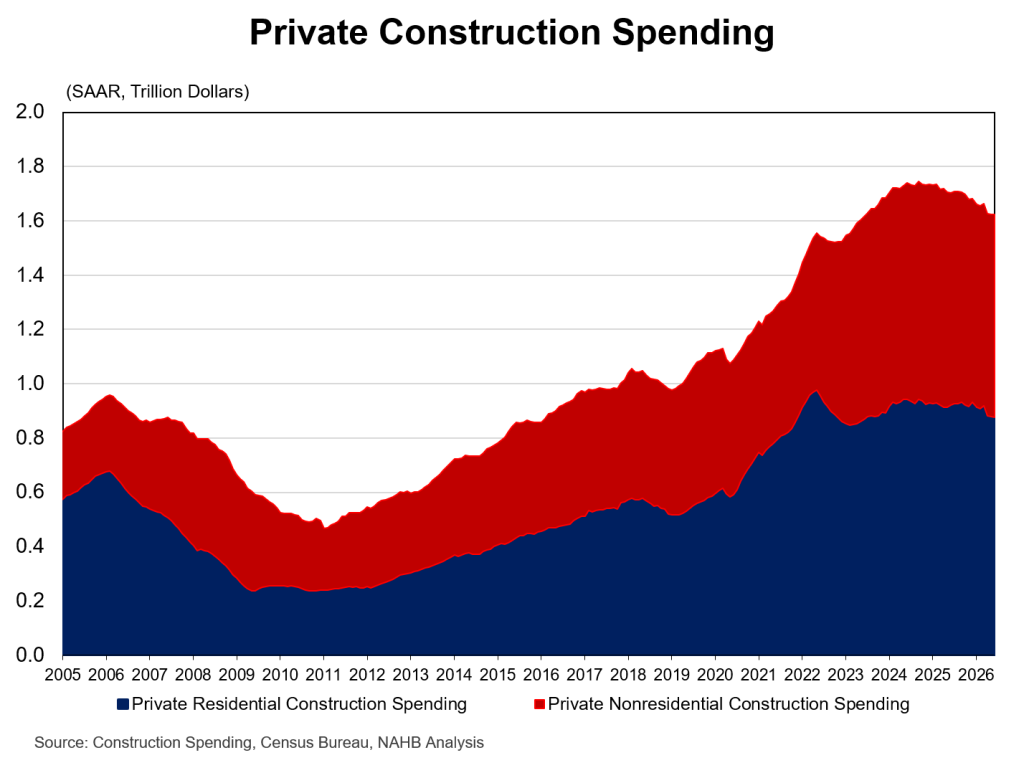
In June, private residential construction spending was $877.1 billion, a seasonally adjusted annual rate (SAAR) that was 0.3% lower than the revised May estimate and 4.7% lower than the previous year, according to the most recent construction spending data from the U.S. Census Bureau.
The monthly change for May was also revised downward, from an initial reported 0.3% increase to a 0.3% decline.
Despite the fact that remodeling was the sole residential category to experience an increase in June, the increase was only modest, at 0.1%.
Spending has decreased by 7.2% when contrasted with the previous year.
The Census has also significantly reduced the most recent April and May estimates.
May’s change was altered from a 0.9% increase to a 0.4% decline, while April’s month-over-month change was revised from a 1.6% increase to a 10.1% decline.
April was revised from a 10.0% increase to a 2.6% decline on a year-over-year basis, while May was revised from an 8.1% increase to a 5.5% decline.
The direction of the monthly movements of single-family and multifamily construction spending was not affected by the minor revisions.
In June 2026, single-family construction spending experienced a 0.6% decline, which is in line with the weak builder sentiment depicted in the NAHB/Wells Fargo Housing Market Index (HMI).
On a yearly basis, single-family spending has declined by 3.3%.
Additionally, there was a 0.7% decline in multifamily construction spending from May and a 1.5% decline from a year ago.
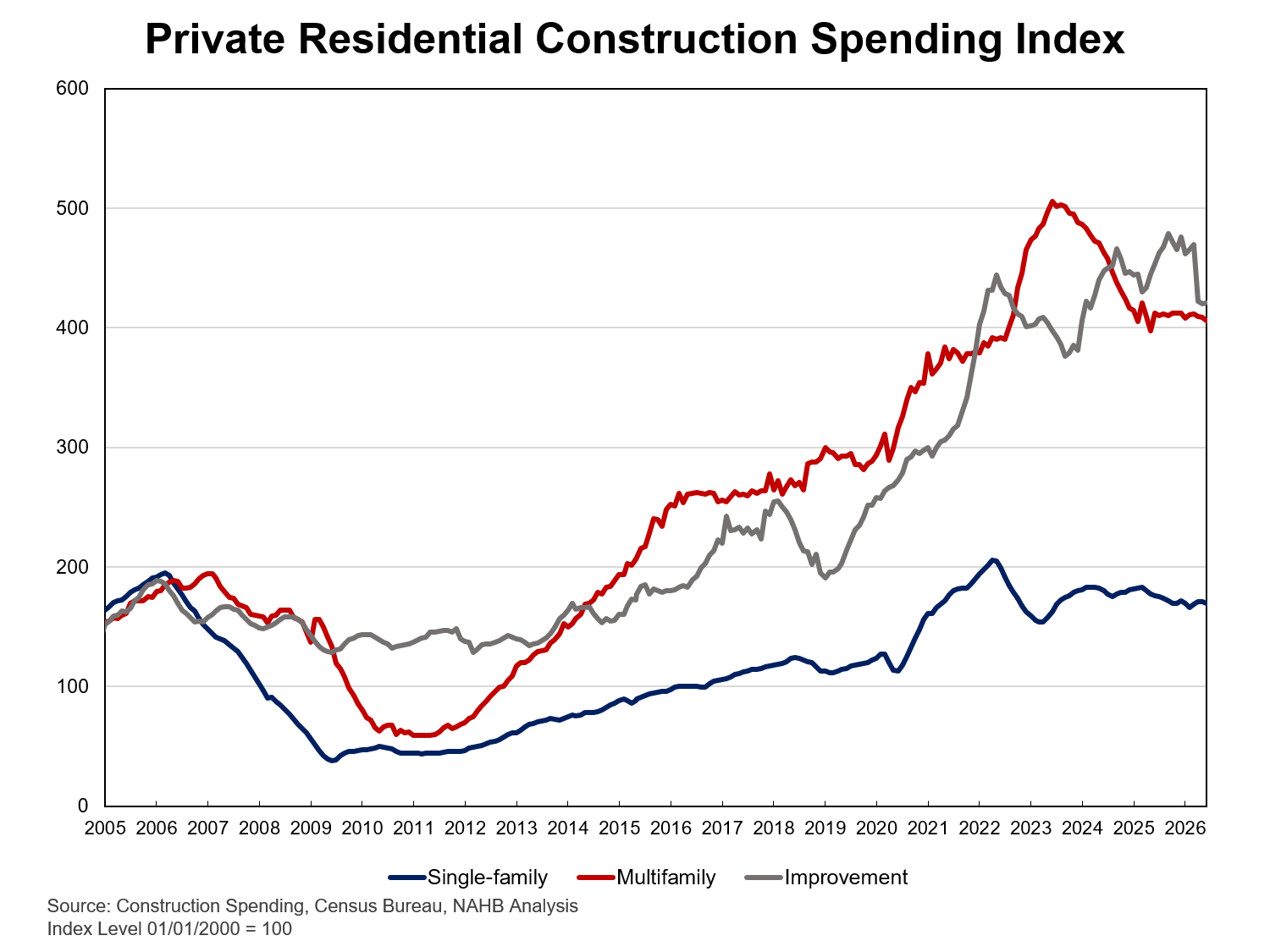
The graph below illustrates the NAHB construction expenditure index.
The index illustrates the slowdown in single-family construction spending that has occurred since early 2024, which is a result of the ongoing ambiguity surrounding building material tariffs and elevated interest rates.
The index has largely plateaued since late 2024, and multifamily construction expenditure growth has also slowed down since the peak in June 2023.
In contrast, the aging housing stock and the persistent demand for renovations have contributed to an upward trend in improvement spending since 2023.
Nevertheless, the most recent revision suggests that a decline may occur in 2026.
In June, private nonresidential construction expenditures increased by 0.1% to a SAAR of $745.3 billion, but they remained 4.7% below their year-ago level.
In the interim, the expenditure on data centers, a subcategory of office construction, remained robust, with a 7.0% month-over-month increase and a 45.8% year-over-year increase.
The proportion of data centers in the total expenditure on office construction has increased from 45.8% a year ago to 59.0% in June 2026.
[Read more about this topic on eyeonhousing.org.]