

According to NAHB, the United States has a structural housing deficit of 1.2 million units.
The industry’s chronic shortage of workers in the construction trades is one of the numerous obstacles that home builders encounter in their efforts to address this disparity.
An estimate conducted by the NAHB for the Home Builders Institute indicates that this shortage results in an estimated $11 billion in annual costs and missed construction.
In order to address the housing deficit, it will be necessary to recruit younger workers who are interested in pursuing a career in the construction industry.
The latest NAHB survey research illuminates the perspective of young adults aged 18 to 25 regarding the construction professions and, to the extent feasible, compares the results to those of a comparable study conducted a decade ago.
This research reveals an enhanced interest in the construction professions among young adults, serving as an update to the 2016 study.
This occurs during a time when the future of labor is being called into question by the impact of technology and evolving economic conditions. Nevertheless, there is still a relatively low level of interest in construction among young adults, necessitating additional effort.
Although the majority of young adults are aware of the field in which they aspire to (or presently hold) a career, there is a decreasing degree of certainty regarding their career choice.
In 2016, 74% of individuals were aware of the field in which they aspired to work. In 2026, this percentage has decreased to 65%. The decrease is likely to be linked to evolving labor market dynamics and broader economic uncertainty.
The home building industry experienced a positive development during this period, as the percentage of individuals interested in a vocation in the construction trades doubled from 3% to 6%.
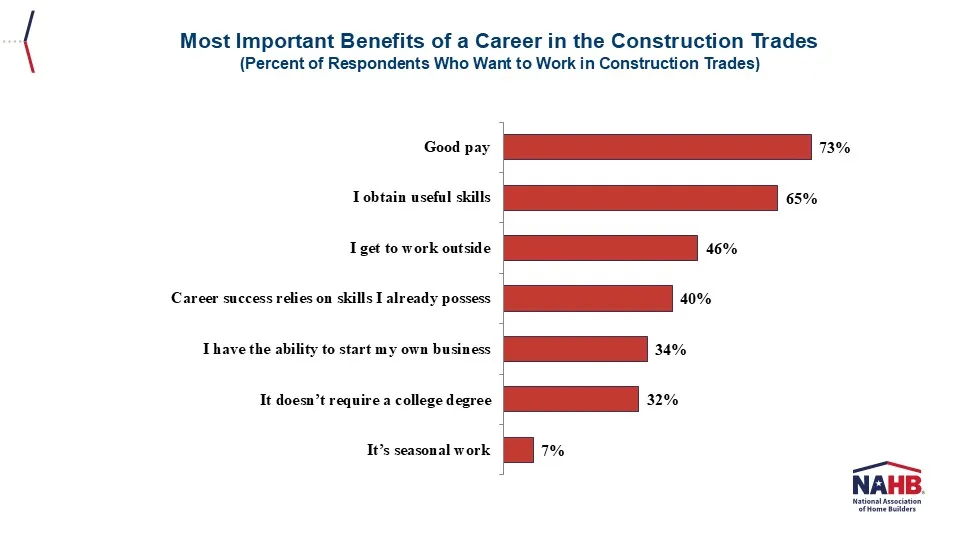
Good pay (73%) and the acquisition of practical skills (65%) are the two most significant advantages they perceive in a career in the crafts.
A follow-up question was administered to young adults who lacked a clear sense of career direction.
The question asked them to rate the likelihood that they would consider a variety of fields, including construction trades, on a scale of 1 to 5, with 1 representing “no chance no matter the pay” and 5 representing “very good chance if the pay is high.” Construction professions were ranked fourth out of 13 potential fields in 2026, with an average rating of 2.6.
The trades were rated ninth on the same list a decade ago and received an average rating of 2.1.
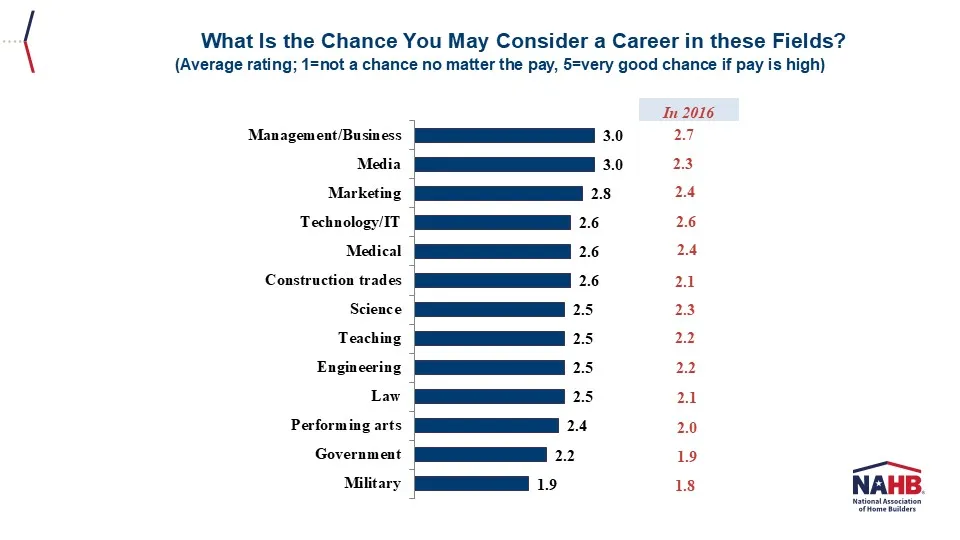
The results also indicate that 51% of young adults who are undecided about a field of work would be hesitant to contemplate a career in the trades, regardless of pay (rated it a 1 or 2). Nevertheless, that percentage has decreased from 63% in 2016.
Conversely, 30% of respondents would be inclined to reconsider the trades if compensation were sufficiently high (rated it a 4 or 5). A decade ago, only 18% would have done so.
These changes indicate a notable improvement in the attitudes of young adults toward the construction trades over the past decade, as their propensity to enter the field is more responsive to increased compensation.
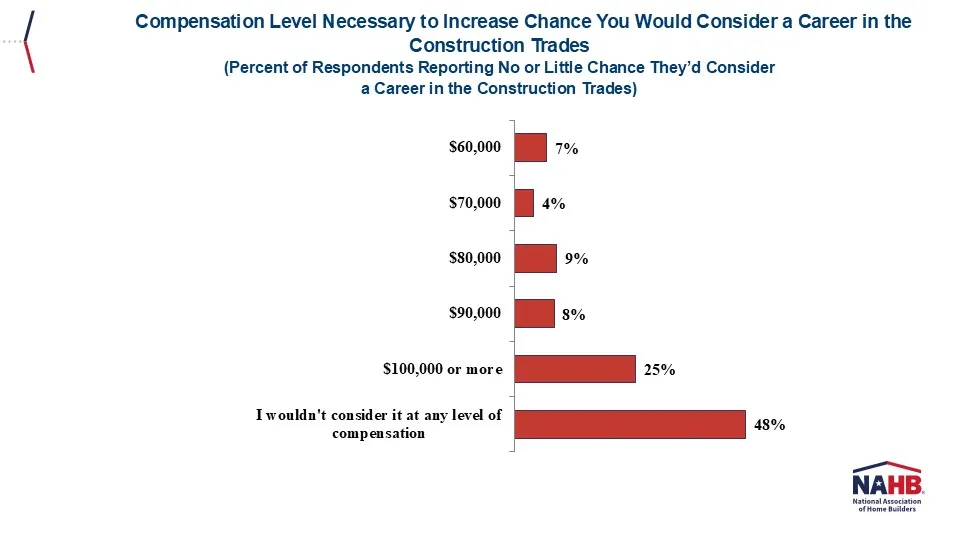
The group that was most hesitant to contemplate a career in the trades was asked in a final question if any compensation level would make them reconsider.
Once again, 48% of respondents confirmed that they would not accept a career in the trades at any level of compensation.
However, a critical discovery for the home construction industry is that the majority of undecided young adults aged 18 to 25 who would not typically pursue a career in the trades would actually reconsider the position if the compensation was appropriate (52%).
The figure is at least $90,000 for 32% of this group and $60,000 to $80,000 for the remaining 20%.
The median annual wages of 12 construction occupations already meet or exceed this threshold.
Click here to access a comprehensive research paper on this subject, which provides a more detailed examination of the attitudes of various subgroups of young adults toward a career in the construction trades, including gender, race/ethnicity, community type (urban, suburban, rural), and region of the country.
[Read more about this topic on Eyeonhousing.org]