

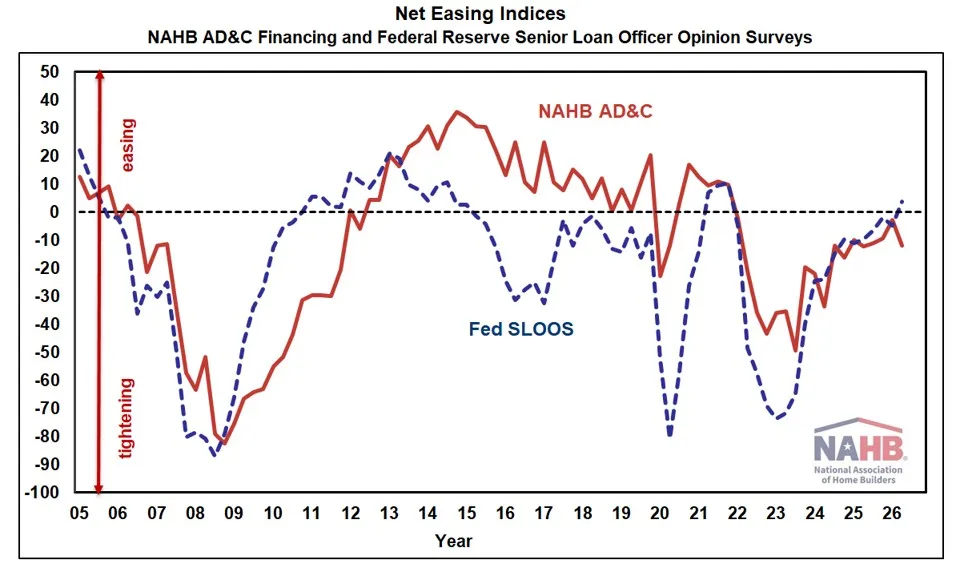
According to NAHB’s quarterly survey on AD&C Financing, credit conditions on loans for residential Land Acquisition, Development & Construction (AD&C) were still tightening in the second quarter of 2026.
The second-quarter reading of the net easing index, which is derived from the survey, was -12.0, indicating net tightening.
Residential builders and developers have reported tightening credit conditions for the eighteenth consecutive quarter.
Conversely, the same net easing index, which is derived from the Federal Reserve’s survey of lenders, increased marginally above zero in the second quarter, with a reading of +3.7..
Since NAHB began comparing the two series in 2013, this is the first instance in which lenders reported loosening credit conditions while builders and developers were concurrently reporting tightening.
A previous post contained additional information regarding the Federal Reserve’s survey of lenders, which encompassed measures of demand and net easing for residential mortgages.
In the second quarter, 53% of NAHB builders and developers reported that lenders tightened credit conditions by requiring personal guaranties or collateral unrelated to the project.
This approach placed the entire business, rather than just an individual project, at risk.
The interest rate increase, the reduction of the loan-to-value or loan-to-cost ratio, and the refusal to make relationship loans were all reported by 47% of builders and developers, and they were tied for second place on the list of prevalent ways lenders were tightening.
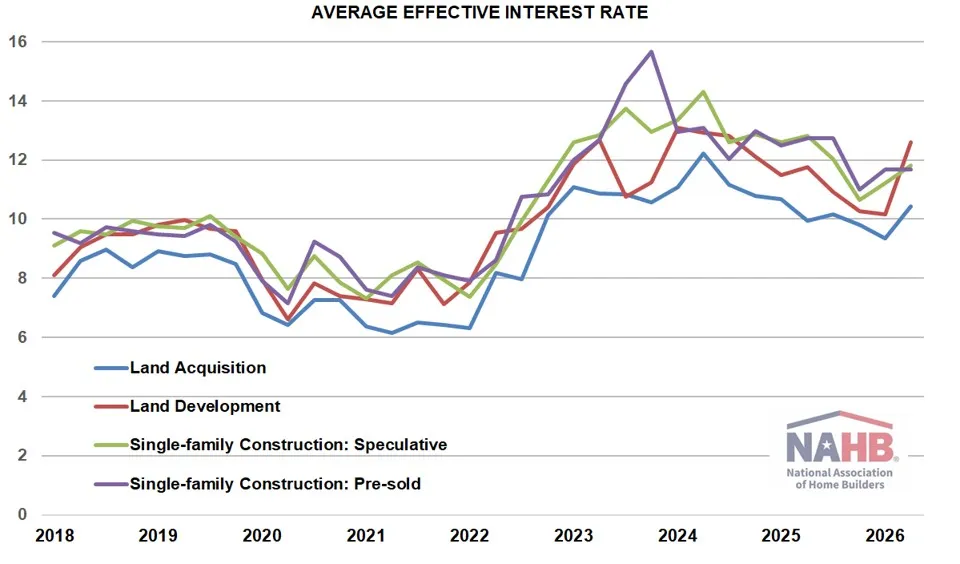
Also in the second quarter, NAHB builders and developers generally reported an increase in the cost of credit, with a few exceptions.
The average contract rate increased in two of the four categories of loans tracked in the AD&C survey: loans for land acquisition increased from 7.42% to 7.77% and loans for land development increased from 7.27% to 8.09%.
In contrast, the contract rate experienced a modest decrease in the other two categories: loans for speculative single-family construction, which decreased from 7.31% to 7.28%, and loans for pre-sold single-family construction, which decreased from 7.19% to 7.01%.
The initial points charged on the loans can be a particularly strong driver of the overall credit cost, particularly when the loans are paid off as quickly as is typical in single-family construction.
In the second quarter of 2026, the average initial points of all four categories of AD&C loans increased.
This increase was as follows: from 0.50% to 1.05% on loans for both land acquisition and land development, from 0.62% to 0.85% on loans for speculative single-family construction, and from 0.55% to 0.71% on loans for pre-sold single-family construction.
Those modifications resulted in the average effective interest rate for financing for pre-sold single-family construction remaining essentially unchanged at 11.67% (compared to 11.68% in the first quarter).
This rate is calculated by incorporating both the contract rate and initial points.
The average effective rate for the other three classes of AD&C loans, which include loans for land acquisition, land development, and speculative single-family construction, increased from 9.36% to 10.43%, 10.15% to 12.59%, and 11.22% to 11.82%, respectively.
The average effective rate for all four categories of AD&C loans was more than 0.6 percentage points higher in the second quarter of 2026 than it had been at the end of 2025.
For instance, the recent post on tepid existing home sales by Eye on Housing has garnered significant attention regarding the adverse impact of elevated mortgage rates on housing affordability.
Nevertheless, the cost of credit has an impact on housing markets in addition to mortgage rates.
The availability of AD&C credit at a reasonable cost is a critical factor in facilitating the expansion of the supply of affordable housing for builders and developers.
The AD&C Financing Survey web page of NAHB provides additional information regarding credit conditions for residential builders and developers.
[Read more about this topic on eyeonhousing.org]