

According to the July 2026 NAHB/Wells Fargo Housing Market Index (HMI) survey, material costs increased by 6.7% from the previous year.
The cost of materials for the same house increased by up to 15% over the past year, according to a significant majority (72.9%) of the builders who responded to the survey in early July.
The most prevalent response (28.4% of builders) was that material prices had increased by 5% to 9.99%.
The next most common response was 22.4%, who indicated a change of less than 5%, and 22.1%, who indicated a change of 10% to 14.99%.
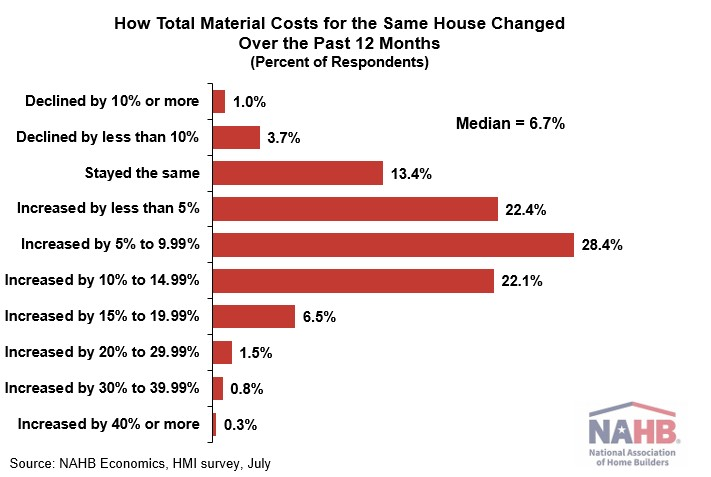
The median annual increase in material costs for the same house was 6.7%.
This is consistent with the 6.7% annual increase in the price of commodities (including energy) used in new residential construction that NAHB reported in its most recent post on the July Producer Price Index. The PPI for goods utilized in new residential construction increased by 5.0% during that period when energy is excluded.
Nevertheless, not all constructors encountered the same degree of growth.
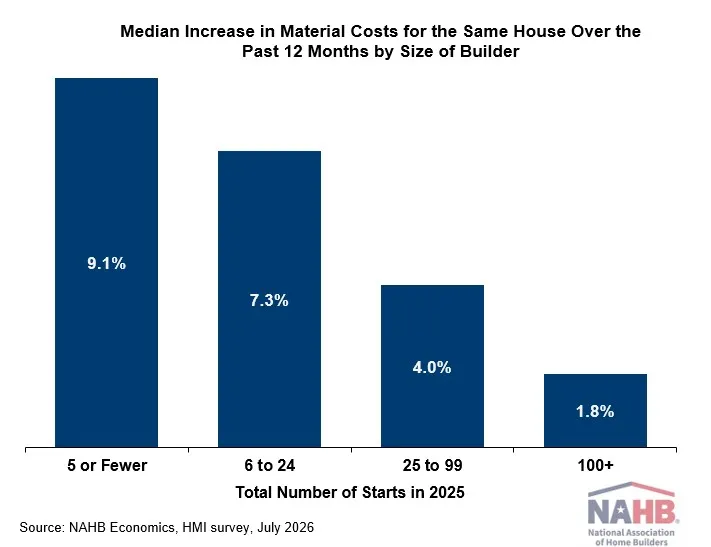
The HMI survey indicates that the median annual increase in material prices decreases consistently as the size of the builder increases.
For builders who initiated five or fewer homes in 2025, the increase was a maximum of 9.1%, while it was only 1.8% for builders who initiated one hundred or more homes.
There are numerous plausible explanations for this tendency.
For example, larger constructors may have a greater capacity to accumulate materials in anticipation of price increases.
Additionally, suppliers may have longer-term contracts with larger builders, which would secure current prices for an extended period.
Finally, larger contractors may be more likely to have special relationships with specific suppliers, which may enable them to negotiate deferred price increases.
Housing affordability challenges in the United States are influenced by a variety of factors, including the cost of materials.
Other factors include the scarcity of qualified construction labor, relatively high mortgage rates, and a variety of regulatory costs.
[Read more about this topic on eyeonhousing.org]