

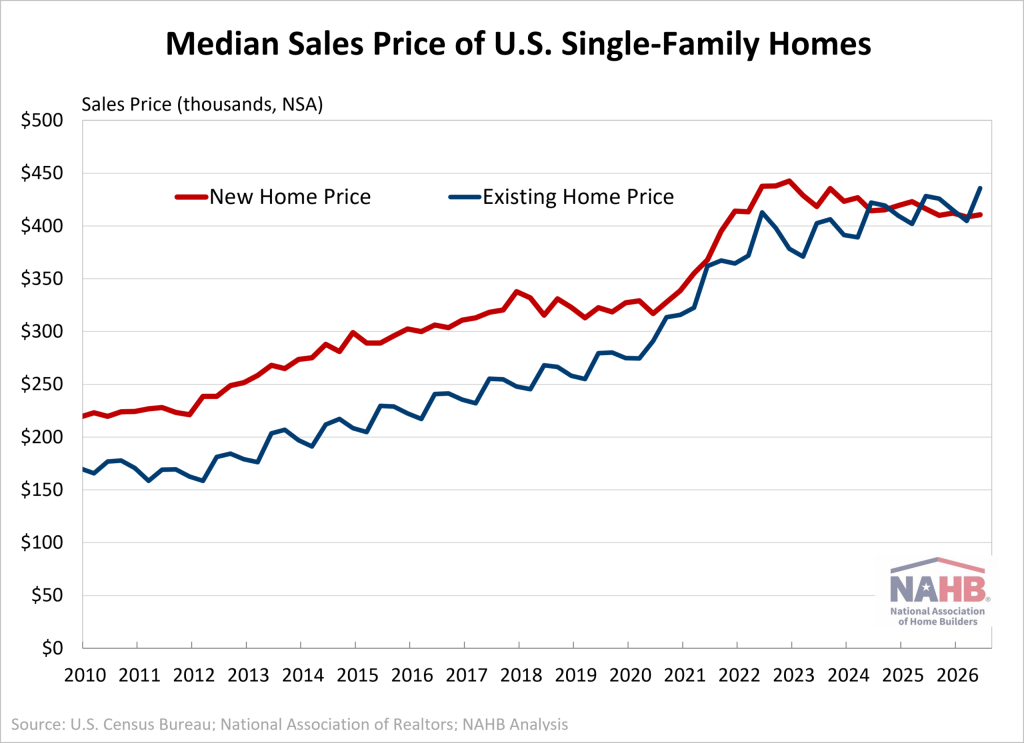
The national median price for a new single-family home was $410,700 in the second quarter of 2026, which was $25,000 less than the national median price of an existing home, which was $435,700.
According to data from the U.S. Census Bureau and the National Association of Realtors (not seasonally adjusted – NSA), this represents the most significant disparity between the national median trends for existing and new home prices.
Nevertheless, the national trend reversal is most effectively comprehended as a regional and compositional phenomenon.
In the past, the national median prices of new homes have tended to exceed those of existing residences.
This relationship, however, reversed in the second quarter of 2024, with the national median existing home prices surpassing new home prices in six of the previous nine quarters.
This new trend is the result of a combination of factors.
The prices of existing homes are continuing to rise as a result of a scarcity of inventory.
This is due to the fact that many householders who secured low mortgage rates during the pandemic are hesitant to sell due to the persistently high interest rates.
In contrast, the pricing of new homes is more volatile, as it is influenced by the varieties and locations of the homes that are being constructed.
Home builders are addressing affordability challenges by constructing smaller homes, building on smaller lots, and offering incentives, despite the numerous challenges that the industry is currently confronting.
New homes are also moving away from dense population centers (more costly) and toward smaller metro/micro areas (less expensive), according to NAHB’s Home Building Geography Index.
Home building has shifted toward the South, which is associated with less costly homes due to policy and regulatory effects.
This shift is geographically based.
This has occurred in a context where construction costs are on the rise, which is the primary factor influencing the prices of both new and existing homes.
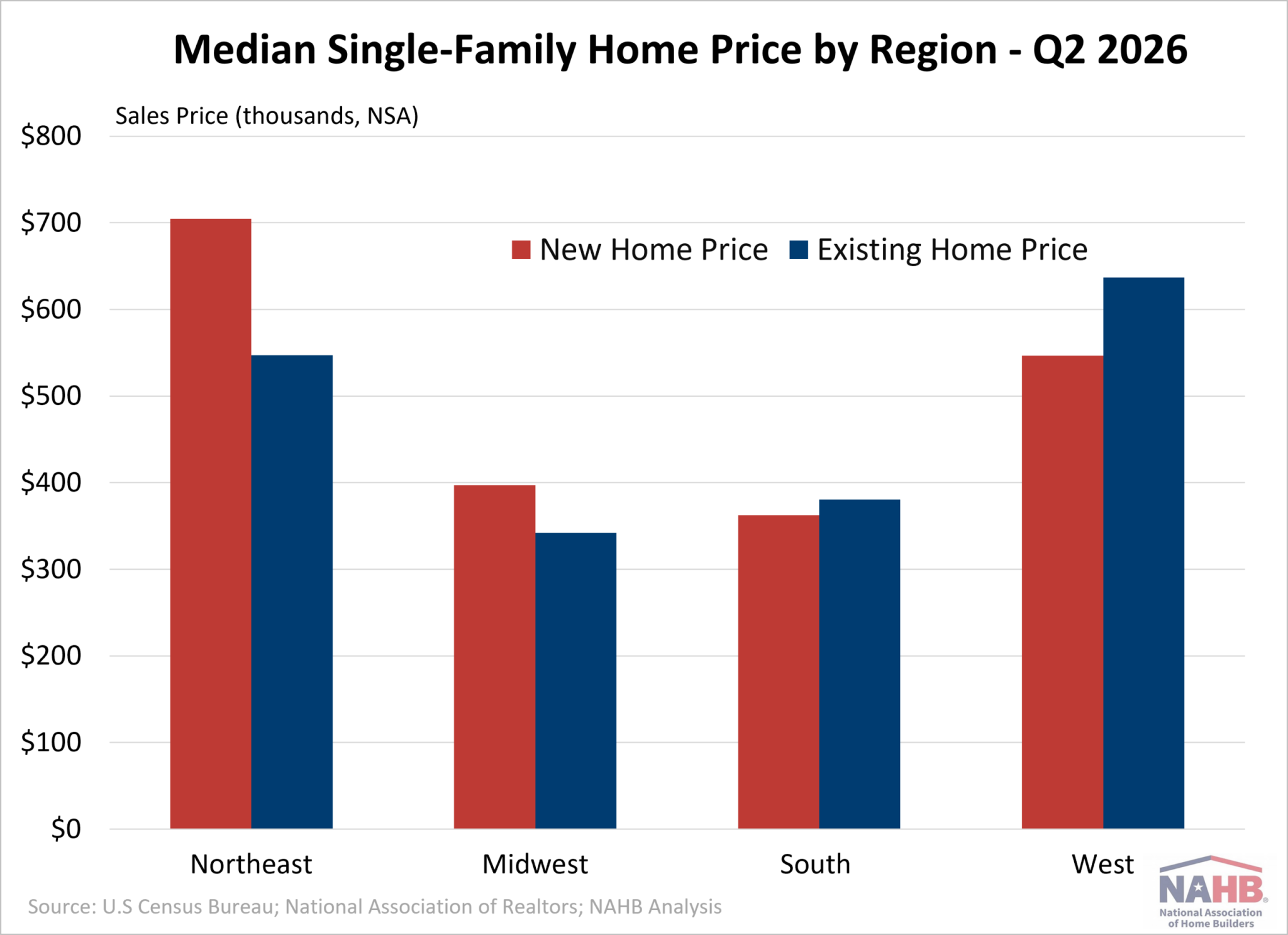
While the national tendency indicates that existing homes are priced at a higher median than new homes, this trend is limited to two geographic regions: the South and the West.
In contrast, the Northeast and Midwest exhibit the opposite trend.
The prices of new and existing homes can fluctuate across regions as a result of a variety of underlying factors, such as regulations, land and construction costs, home and lot sizes, location (urban versus rural), housing stock, and local market conditions.
Southern regions were the least expensive for new residences in the second quarter, with a median price of $362,500.
Following closely behind was the Midwest, with a total of $397,200.
The Midwest was the least costly region for existing homes, with a price of $342,000.
The South was the second most expensive region, with a price of $380,600.
The Northeast had the highest median price of $704,700 for new residences, while the West had a median price of $546,700. At $636,900, the West was the most expensive region for existing properties, with the Northeast following at $546,900.
In the Northeast, the new home price premium was most pronounced, with new homes selling for $157,800 more than existing homes.
Furthermore, in the Midwest, the price of new homes was $55,200 higher than that of existing homes.
The national trend was established by the West and South, where existing homes were priced $90,200 higher than new homes in the West and $18,100 higher in the South.
Following the pandemic, the prices of both new and existing residences experienced substantial increases as a result of the limited supply and increased construction costs.
Despite the fact that home prices remain unaffordable in comparison to historical norms, new home prices have moderated as a result of strategic business decisions made by builders.
Conversely, existing home prices continue to rise as a result of a lack of price discovery for existing homeowners and a lean supply in certain markets.
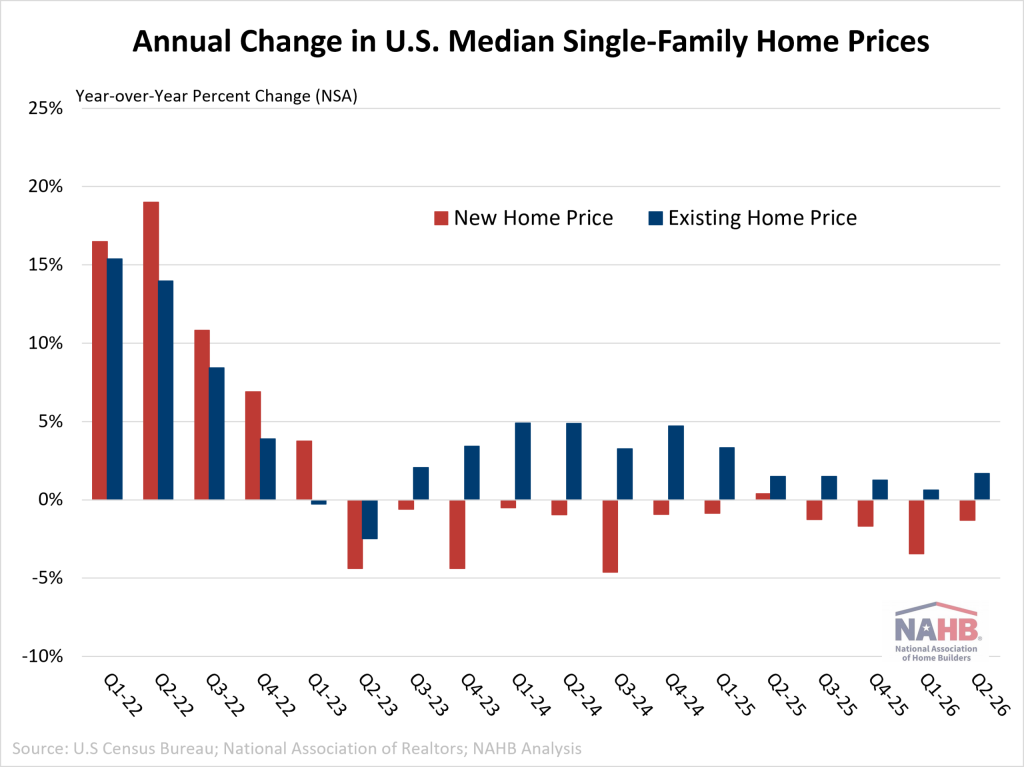
In 2026, the national median price of a new single-family home that was sold in the second quarter decreased by 1.3% compared to the previous year.
Since the second quarter of 2023, the annual growth rate of new home prices has been decreasing.
While existing home prices have maintained a year-over-year increase for the past twelve quarters, the annual growth rate has declined from a peak of 4.9% two years ago to 1.7% in the second quarter of 2026.
[Read more about this topic on eyeonhousing.org]