

In April, the housing market experienced a significant decline in builder sentiment as it entered the spring buying season, which was exacerbated by economic uncertainty, rising construction material costs, and interest rates.
The National Association of Home Builders (NAHB)/Wells Fargo Housing Market Index (HMI) reported that builder confidence in the market for newly constructed single-family homes decreased by four points to 34 in April.
This is the lowest level observed since September 2025.
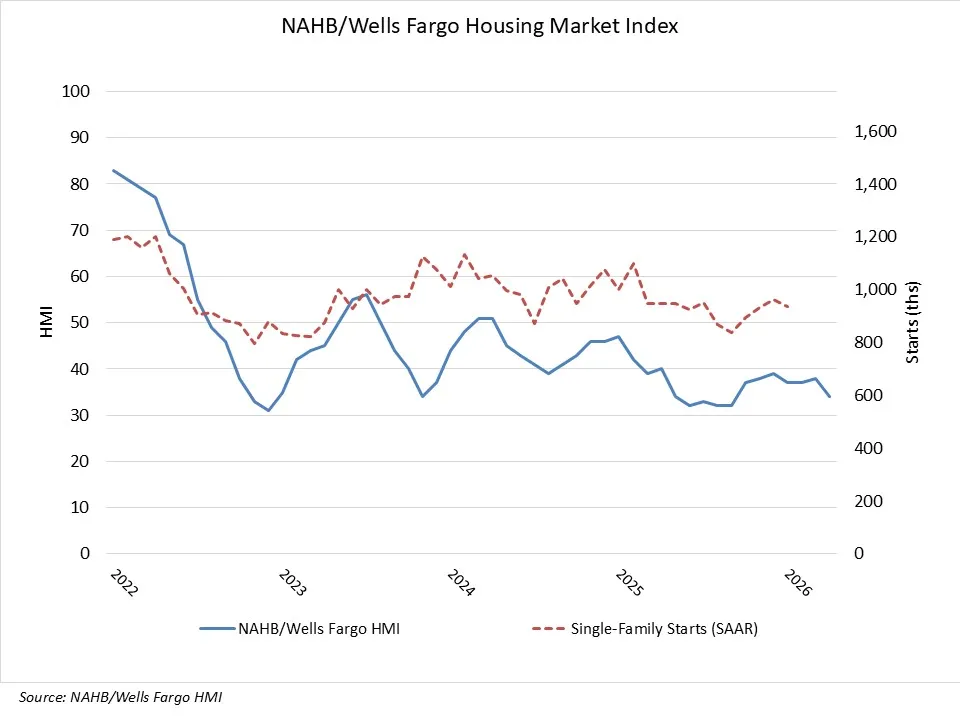
Builder sentiment experienced a decline in the spring as purchasers grappled with the persistently high interest rates and the increasing economic uncertainty.
The year began with expectations of a surge in housing momentum; however, the market has been impeded by concerns regarding the Iran conflict, energy costs, and consumer confidence.
62% of builders reported that suppliers have increased the cost of construction materials as a result of the increased cost of fuel, including gas and diesel, in the United States, as a result of the rising price of oil.
Residential construction material input and service costs are approximately 4% comprised of energy costs.
Given the ambiguity surrounding material costs, 70% of builders reported experiencing difficulties in pricing homes amid elevated near-term economic risks.
Additionally, the most recent HMI survey indicated that 36% of builders reduced their prices in April, a minor decrease from the 37% who did so in March.
The average price reduction was 5%, a decrease from the 6% figure in March. In April, sales incentives were utilized at a rate of 60%, a decrease from the 64% observed in March.
This represents the 13th consecutive month in which this percentage was at or above 60%.
The NAHB/Wells Fargo HMI, which is based on a monthly survey that NAHB has been conducting for over 40 years, assesses builder perceptions of present single-family home sales and sales expectations for the next six months as “good,” “fair,” or “poor.”
The survey also requests that builders evaluate the traffic of potential purchasers as “high to very high,” “average,” or “low to very low.”
The scores for each component are subsequently utilized to generate a seasonally adjusted index.
A value greater than 50 indicates that a greater number of builders perceive the conditions as favorable than unfavorable.
In April, each of the three principal HMI indices experienced losses.
From March to April, the HMI index that measures current sales conditions decreased by four points to 37, the index that measures future sales decreased by seven points to 42, and the index that charts the traffic of prospective purchasers decreased by three points to 22.
Upon examining the three-month moving averages for regional HMI scores, the Northeast experienced a two-point decrease to 42, the Midwest experienced a two-point decline to 41, the South remained at 35, and the West experienced a three-point decline to 29.
The HMI tables are available at nahb.org/hmi.
[Read more about this topic on Eyeonhousing.org]