

According to NAHB analysis of the most recent 2023 American Community Survey (ACS) data, the median age of the construction labor force is 42, which is one year older than the average worker in the national labor force.
However, more young workers are entering the construction business. Despite considerable progress since the peak of the skilled labor crisis in 2021, acquiring talented personnel remains the major long-term goal of the construction industry.
The median age of the construction labor force varies by state. The color coding on the map below represents the median age of people working in the construction business.
Alaska has the oldest median age (46 years old), followed by Connecticut and Maine, where the typical age for construction workers is 45.
The construction labor force is younger on average in the center section of the country. For example, half of Utah’s construction workers are under the age of 39.
The second data series plotted above shows the difference between the median age of construction workers in each state and the median age of all industrial workers.
These estimations are presented as numbers displayed on each state. A positive figure shows that construction workers are older than the average worker in the state.
Alaska has the greatest disparity, with the median age of the construction labor force being 6 years greater than the total median in the state.
On the other hand, a negative value suggests that the construction labor force is generally younger than the state labor force.
In Vermont and Delaware, the median age of construction workers is two years lower than the population median.

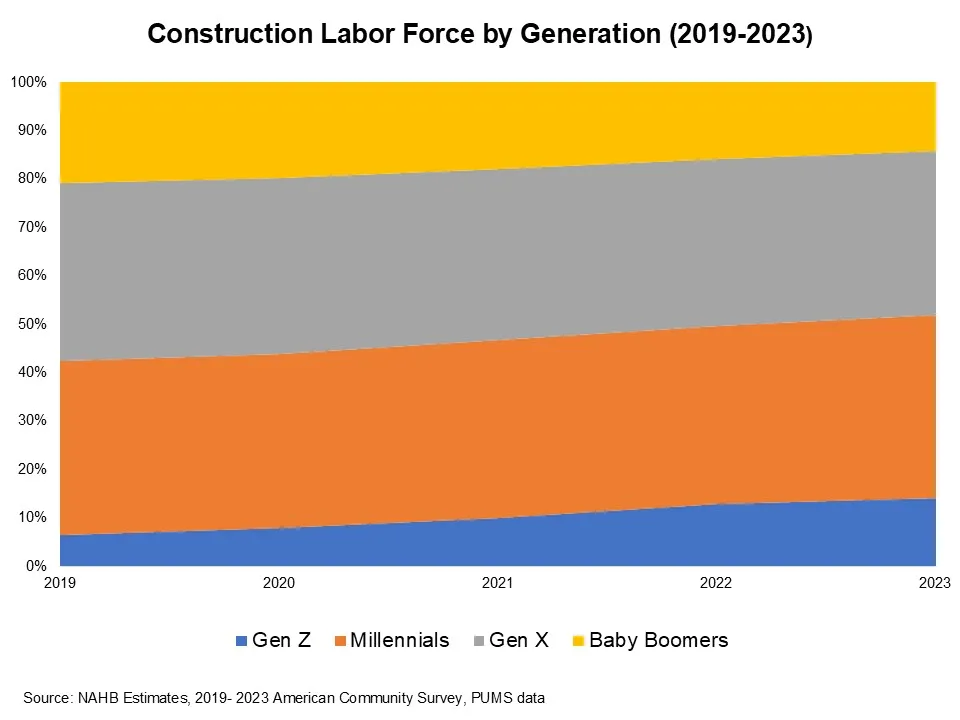
An analysis of the age distribution of construction workers across time shows that Gen Z, those born between 1997 and 2012, are more likely to enter the profession than Millennials, who were the youngest generation in the labor market.
They are lured to employment in the construction business because of factors such as new developments in current construction technologies, high college education prices, competitive construction pay, job security, and opportunities for advancement.
Generational trends are altering the construction workforce. Gen Z’s proportion has more than doubled, rising from 6.4% in 2019 to 14.1% in 2023, indicating a growing pipeline of young workers. Millennials’ proportion also increased from 35.7% to 37.7% throughout the same period.
In contrast, Gen X fell from 36.6% to 33.7%, while Baby Boomers plummeted dramatically from 20.6% to 14.2% as workers began to retire.
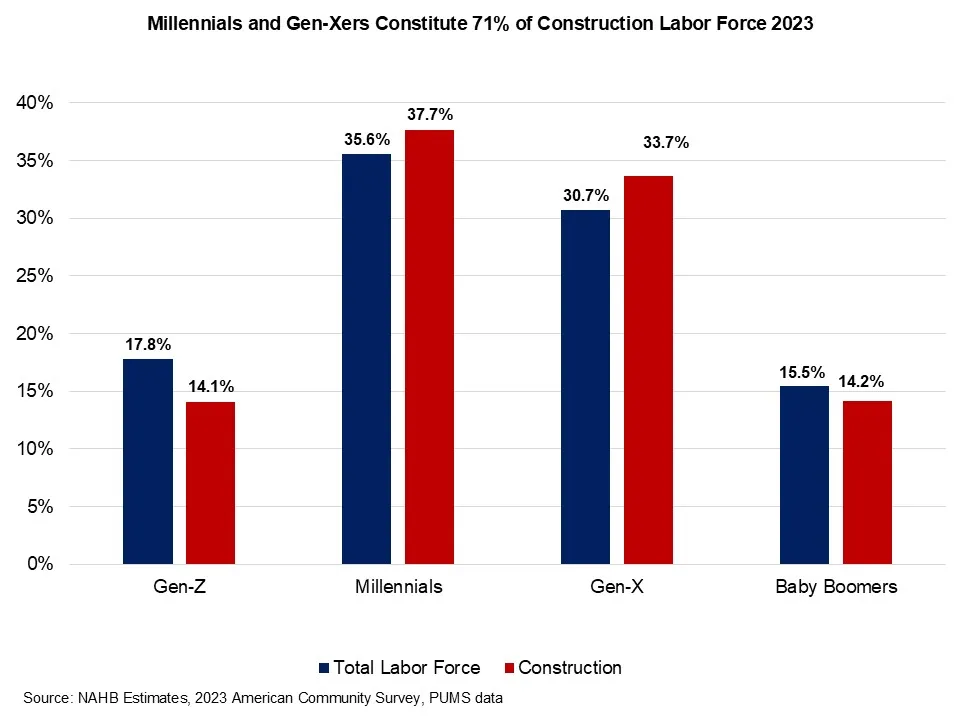
According to the chart below, Gen Zers accounted for only around 14.1% of the construction labor force in 2023.
Millennials and Gen-Xers, who are regarded to be in their prime working years, accounted for approximately 71% of the construction labor force, compared to 66% of the total labor force.
The fact that Gen X makes up a larger proportion of the construction labor force highlights the current labor shortfall.
Gen X is a smaller generational cohort than Baby Boomers. Baby Boomers account for 14.2% of the construction labor force, meaning that a significant chunk of the labor force will retire in the near future.
Attracting more trained workers, particularly from younger generations, is the key long-term goal of the construction sector.
[Read more about this topic on Eyeonhousing.org]