

Builder confidence edged higher at the end of the year, but it remains in negative territory as builders battle with increased building costs, tariffs, and economic uncertainty, and many potential buyers stay on the sidelines owing to affordability worries.
The National Association of Home Builders (NAHB)/Wells Fargo Housing Market Index (HMI) reported that builder confidence in the market for newly built single-family homes increased one point to 39 in December.
Sentiment levels were consistently lower than the breakeven point of 50 in 2025, ranging in the high 30s in the fourth quarter.
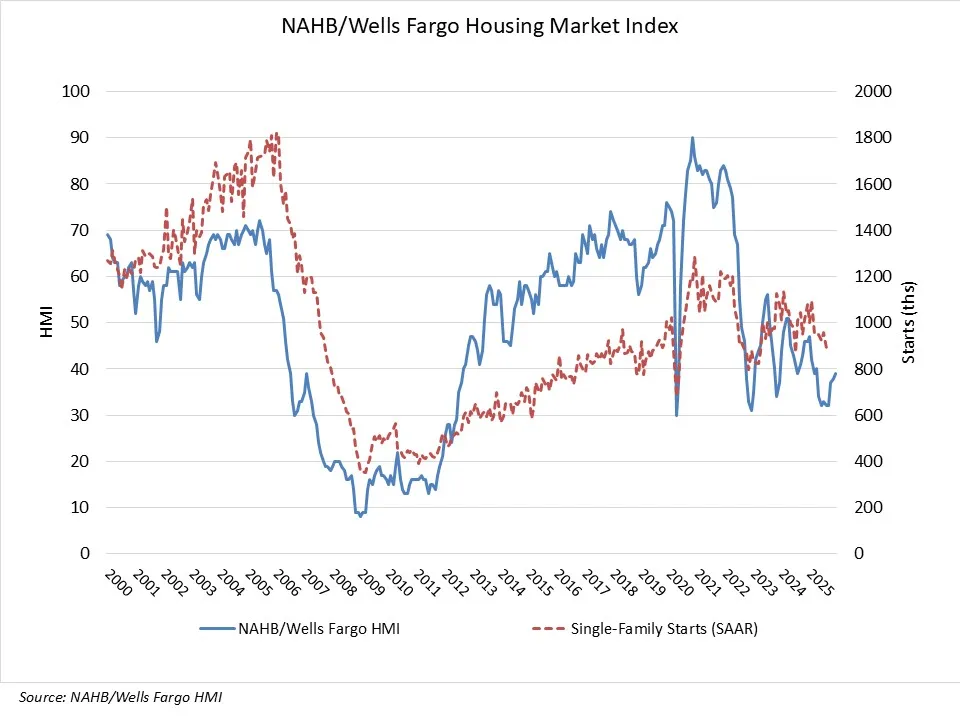
Market conditions remain challenging, with two-thirds of builders reported offering incentives to get customers to buy.
In an encouraging indicator for the market, builders indicate that future sales projections have been over the critical breakeven threshold of 50 for the past three months, and recent monetary policy softening should help builder credit conditions at the beginning of 2026.
However, builders are also facing supply-side challenges, as regulatory costs and material prices remain stubbornly high.
Rising inventory has also heightened competitiveness for newly constructed homes.
In another indicator of the housing market’s persistent troubles, the most recent HMI survey found that 40% of builders reported reducing prices in December, the second straight month the ratio has been at 40% or higher since May 2020.
The rate was 41% in November. Meanwhile, the average price drop in December was 5%, down from 6% in November.
In December, 67% of sales incentives were used, the highest rate seen since the Covid pandemic.
The NAHB/Wells Fargo HMI is based on a monthly survey that NAHB has conducted for over 40 years. It assesses builder perceptions of current single-family home sales and sales projections for the next six months as “good,” “fair,” or “poor.”
The study also asks builders to categorize prospective buyer traffic as “high to very high,” “average,” or “low to very low.”
The scores for each component are then used to produce a seasonally adjusted index, with any value more than 50 indicating that more builders see conditions as excellent than poor.
The HMI index measuring current sales conditions gained one point to 42, the index measuring future sales increased one point to 52, and the gauge tracking prospective buyer traffic remained unchanged at 26.
According to the three-month moving averages for regional HMI scores, the Northeast decreased one point to 47, the Midwest rose two points to 43, the South raised two points to 36, and the West gained four points to 34.
You may find the HMI tables at nahb.org/hmi.
[Read more about this topic on Eyeonhousing.org]