

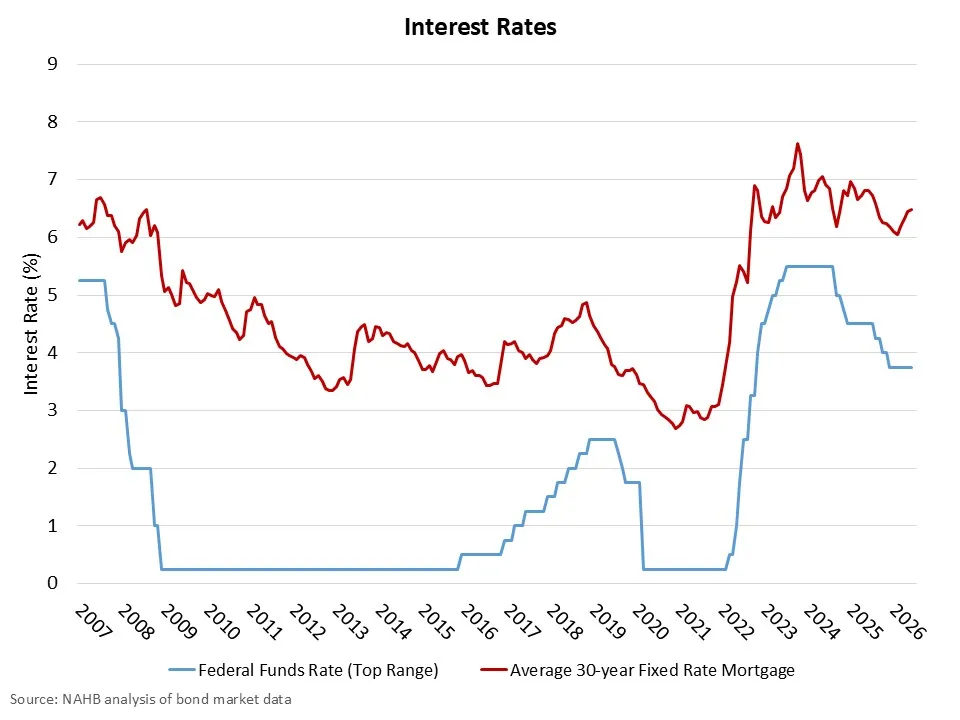
As the housing market continues to be strained by rising material costs, elevated mortgage rates, and ongoing affordability challenges, builder sentiment remains subdued.
In June, the National Association of Home Builders (NAHB)/Wells Fargo Housing Market Index (HMI) reported that builder confidence in the market for newly constructed single-family homes decreased by two points to 35.
This is the 14th consecutive month that sentiment has remained below 40, a trend that has not been observed since the foreclosure crisis of 2011-2012.
Builders are evidently hindered in their capacity to augment the housing supply by regulatory policies that are both costly and inefficient.
An average single-family home’s price is increased by over 26% by government regulation, taxes, fees, and other expenses, according to a recent NAHB study.
The nation’s housing growth would be supported and costs would be reduced by alleviating permitting bottlenecks, density limits, and inefficient zoning rules.
Also, the most recent HMI survey indicated that 35% of builders reduced prices in June, which represents an increase from 32% in May.
In June, the average price reduction was 6%, which was consistent with the previous month.
June saw a modest increase from May’s 61% to 62% in the use of sales incentives, marking the 15th consecutive month in which this percentage has exceeded 60%.
The NAHB/Wells Fargo HMI, which is based on a monthly survey that NAHB has been conducting for over 40 years, assesses builder perceptions of present single-family home sales and sales expectations for the next six months as “good,” “fair,” or “poor.”
The survey also requests that builders evaluate the traffic of potential purchasers as “high to very high,” “average,” or “low to very low.”
The scores for each component are subsequently utilized to generate a seasonally adjusted index.
A value greater than 50 indicates that a greater number of builders perceive the conditions as favorable than unfavorable.
In June, the HMI index that measures present sales conditions decreased by two points to 38.
The index that measures future sales remained constant at 45, and the index that charts the traffic of prospective buyers remained unchanged at 25.
The regional HMI scores for the Northeast increased by two points to 44, the Midwest remained at 43, the South decreased by two points to 33, and the West decreased by one point to 27 when examining the three-month moving averages.
The HMI tables are available at nahb.org/hmi.
[Read more about this topic on Eyeonhousing.org]