

According to the Bureau of Labor Statistics Job Openings and Labor Turnover Survey (JOLTS), there were fewer open opportunities in construction in February than the previous year.
The present level of open jobs is significantly lower than three years ago due to cutbacks in building activity, particularly in housing.
However, recent advances in nonresidential construction have not fully countered housing’s sluggish conditions in terms of construction labor demand.
The number of open jobs in the total economy decreased in February, from 7.24 million in January to 6.88 million.
The February reading was lower than a year earlier (7.24 million) due to a slowing job market.
Previous NAHB study indicated that this figure needs to fall below eight million on a consistent basis for the Federal Reserve to proceed with interest rate cuts.
With national job opportunities expected to continue below eight million, the Fed should be able to eliminate even more.
The number of open construction positions decreased marginally, from 230,000 in January to 202,000 in February. This number was lower than the previous year’s total of 255,000.
The graphic below shows the falling trend of unfilled construction positions since the Fed raised the federal funds rate and homebuilding slowed.
While home building employment was dropping in the second half of 2025, other subsectors of the construction industry expanded (for example, data centers).
This has resulted in volatility within a narrower range in the series since 2024.
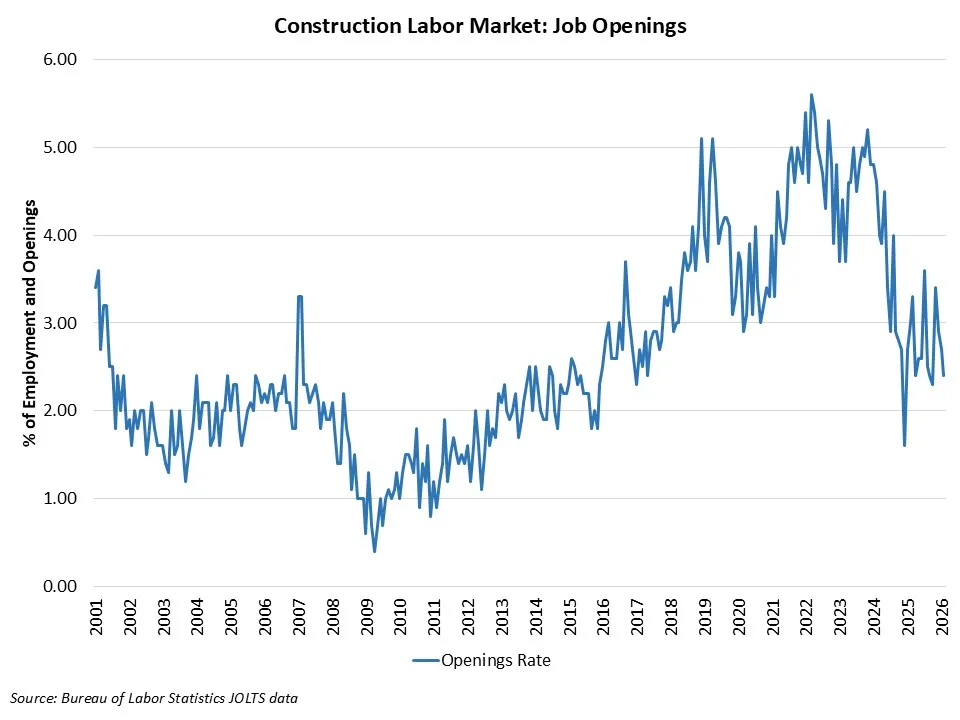
The construction job openings rate fell to 2.4% in February, down from the 3% estimate a year ago.
The construction layoff rate fell marginally to 1.8% in February. The quit rate dropped to 1.3% for the month.
The new data appears to conform to the much-discussed low-hire, low-fire labor market paradigm.
[Read more about this topic on Eyeonhousing.org via Robert Dietz]