

The latest Producer Price Index release from the Bureau of Labor Statistics showed that aggregate residential building material costs climbed at the quickest rate since January 2023.
Input energy prices rose for the first time in almost a year, while service price growth remained lower than goods.
The Producer Price Index for Final Demand rose 0.3% in September after decreasing 0.1% in August.
The final demand goods index rose 0.9% in September, the highest monthly increase since February 2024.
Final demand energy costs accounted for the majority of the goods index rise, up 3.5% in September. This index of final demand for services remained steady in September.
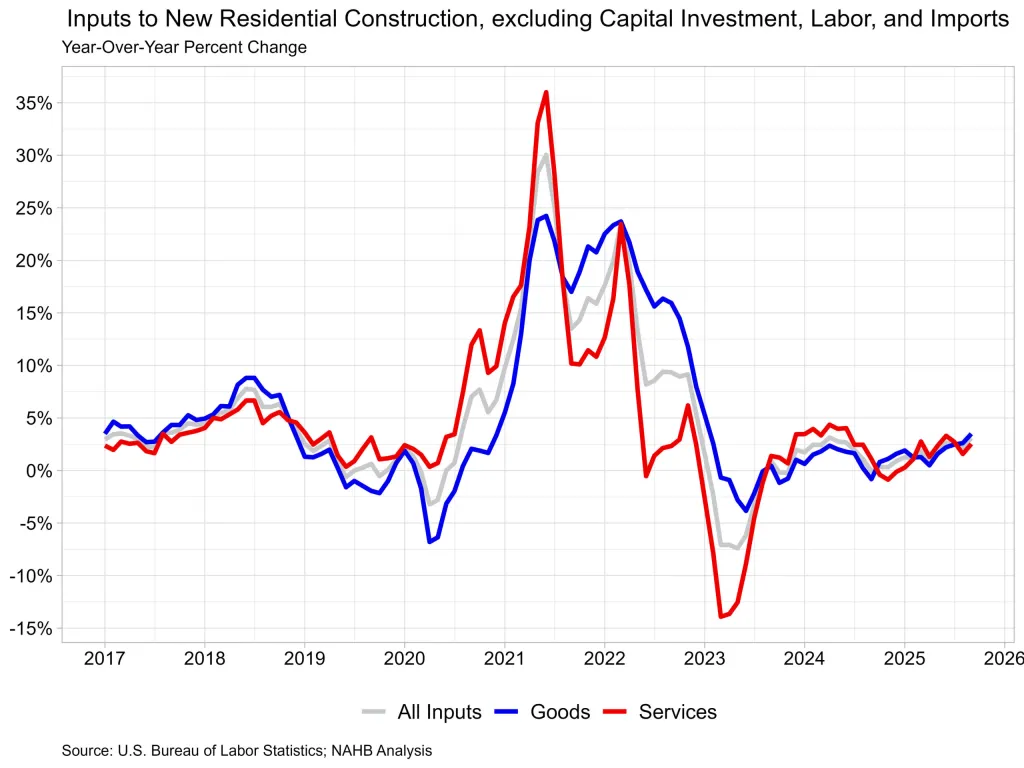
The price index for inputs to new residential construction increased 0.2% in September, bringing it up 3.1% from the previous year.
The price of goods inputs increased by 0.1% over the month and 3.5% over the previous year, while service prices increased by 0.3% over the month and 2.5% over the previous year.
Input goods
The goods component accounts for approximately 60% of the inputs to the residential building price index.
The monthly price of input commodities for new home building increased by 0.1% in September.
The input goods to the residential construction index are further divided into two components, one assessing energy inputs and the other measuring leftover products.
The latter of the two components essentially indicates building materials used in residential construction, which accounts for around 93% of the goods index.
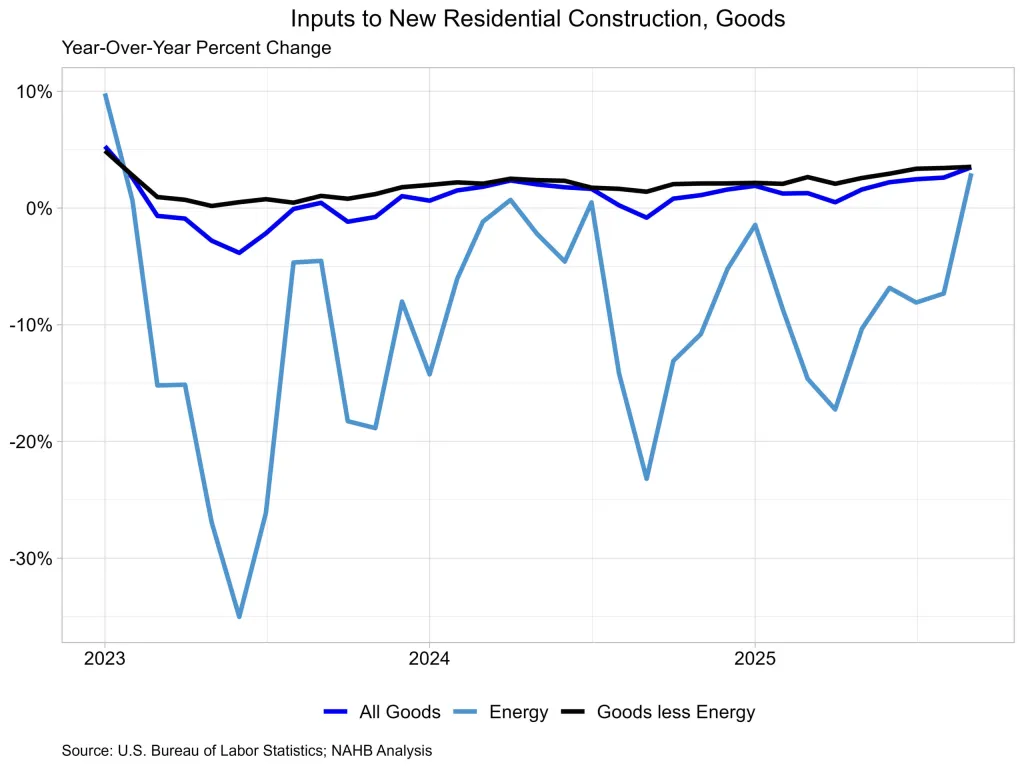
Energy input prices increased by 1.0% in September, and were 3.0% higher than a year earlier. Building material prices increased by 0.1% in September and 3.5% over the previous year.
The 3.5% year-over-year gain is the biggest since January 2023, when it was 4.9%.
After initially hovering at 2.0%, residential building material price inflation gradually increased during the year.
The most significant year-over-year price changes continue to be seen in parts for construction machines and equipment sold individually, which are up 41.3% from September last year. Metal molding and trim prices are up 31.0% over the previous year.
Ready-mix concrete, a vital component in new residential building, has had limited price growth in 2025, rising only 0.4% from the previous year.
In addition, softwood lumber prices fell 2.3% in September compared to last year.
Despite the fact that heavier tariffs have been imposed, lumber prices have fallen in recent months.
Ongoing deficits in new home development in 2025 have resulted in an extreme excess of lumber on the market, with demand falling below estimates.
Input Services
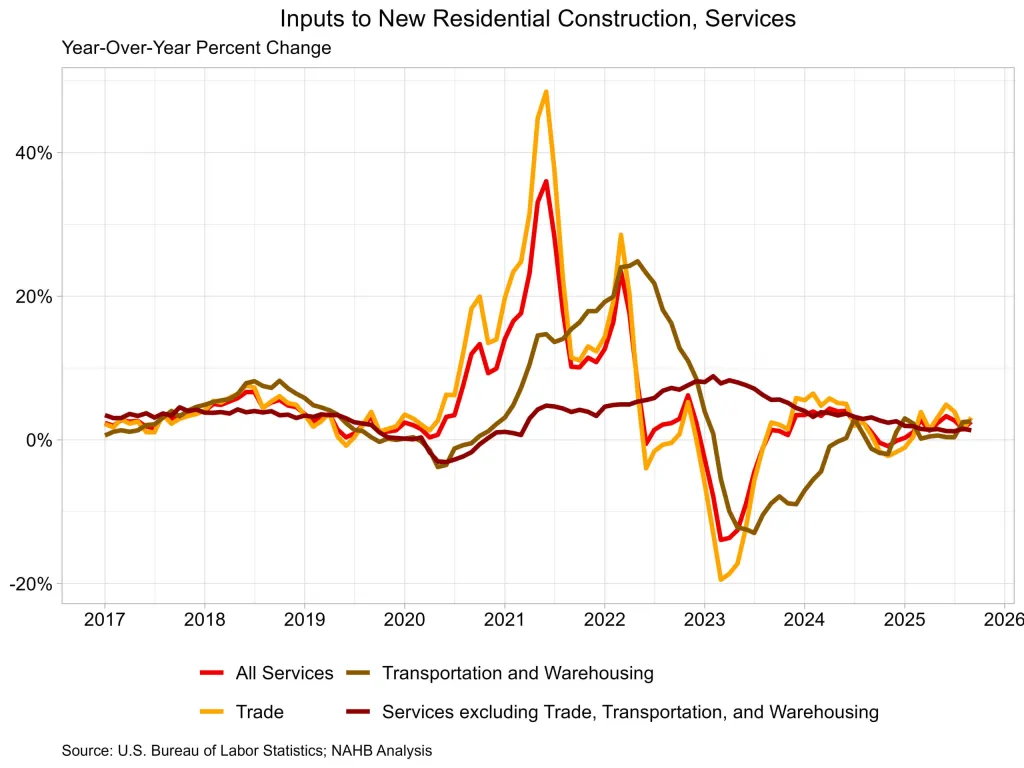
In September, prices for service inputs to residential building rose by 0.3%. Year over year, service input prices increased by 2.5%.
The price index for residential construction service inputs is divided into three components: trade services, transportation and warehousing services, and miscellaneous services.
Trade services account for over 60% of the total, followed by other services (about 29%) and transportation and warehousing services (approximately 11%).
The largest component, trade services, increased 3.1% over the previous year. The other services component increased by 1.3% over the previous year.
Finally, transportation and warehousing service prices increased by 2.6% in August compared to the previous year.
[Read more about this topic on Eyeonhousing.org]