

Builder confidence fell to begin the year as buyers’ affordability concerns remained high, and builders struggled to keep up with escalating building costs.
The National Association of Home Builders (NAHB)/Wells Fargo Housing Market Index (HMI) reported that builder confidence in the market for newly built single-family homes decreased two points to 37 in January.
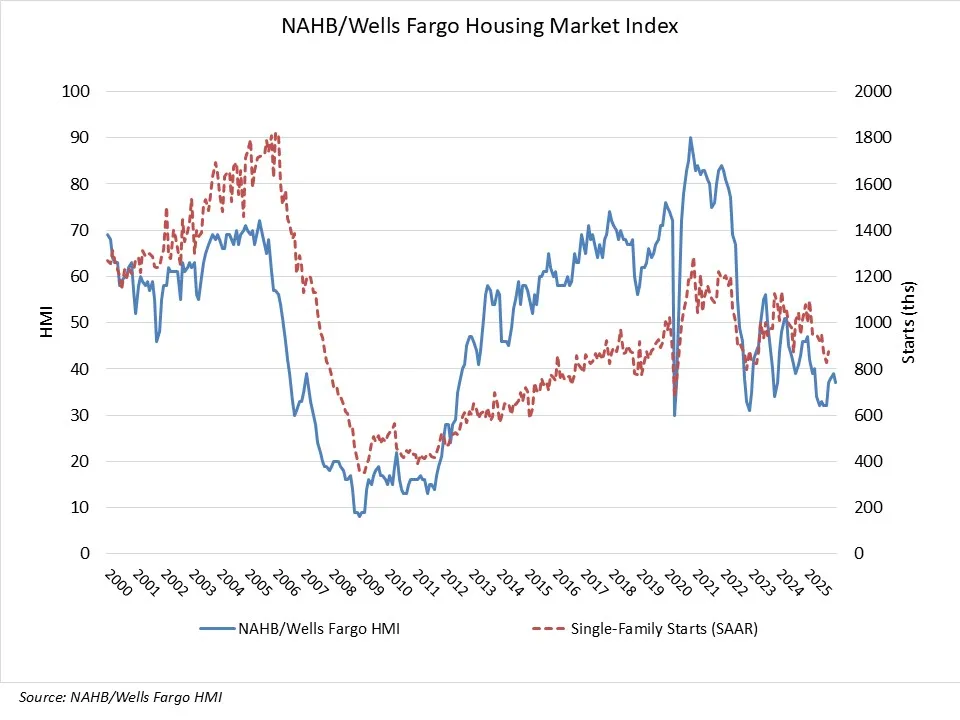
While the upper end of the housing market is stable, affordability conditions are weighing on the lower and mid-range sectors.
Buyers are concerned about rising home costs and mortgage rates, with downpayments becoming increasingly difficult due to high price-to-income ratios.
In a positive development, Freddie Mac revealed that the average mortgage rate dropped to 6.06% on January 15, the lowest rate in three years and over 100 basis points lower than the same period last year.
The majority of responses to the January HMI poll were received prior to the announcement that Fannie Mae and Freddie Mac would buy $200 billion in mortgage-backed securities in an effort to lower interest rates.
While the HMI survey did not take into account the most recent interest rate policy action, builders continue to cite a number of supply-side challenges.
The HMI’s future sales component fell below 50 for the first time since September, showing that builders continue to confront a number of challenges, including labor and lot shortages, as well as higher regulatory and material costs.
In a further indication of the housing market’s persistent troubles, the most recent HMI survey indicated that 40% of builders reported cutting prices in January, unchanged from December but the third straight month the ratio has been at 40% or above since May 2020.
Meanwhile, the average price drop in January was 6%, up from 5% in December.
In January, sales incentives were used at a rate of 65%, marking the tenth consecutive month that this figure topped 60%.
The NAHB/Wells Fargo HMI is based on a monthly poll conducted by NAHB for over 40 years.
It assesses builder perceptions of current single-family home sales and sales projections for the next six months as “good,” “fair,” or “poor.”
The poll also asks builders to rank prospective buyers’ traffic as “high to very high,” “average,” or “low to very low.”
The scores for each component are then used to produce a seasonally adjusted index, with any value more than 50 indicating that more builders believe conditions are good than poor.
All of the HMI subindices dropped in January.
The HMI indicator indicating current sales conditions fell one point to 41, while the gauge measuring prospective buyer traffic decreased three points to 23.
The future sales index dipped three points to 49, the first time it has fallen below the breakeven point of 50 since September.
Looking at the three-month moving averages for regional HMI scores, the Northeast declined two points to 45, the Midwest remained stable at 43, the South dropped one point to 35, and the West increased one point to 35.
The HMI tables can be viewed at nahb.org/hmi.
[Read more about this topic on Eyeonhousing.org via Robert Dietz]