

The most recent Producer Price Index release from the Bureau of Labor Statistics indicates that the price growth of residential building materials increased in February, following a one-month decline.
These figures were finalized prior to the commencement of the conflict in Iran, as the Bureau of Labor Statistics (BLS) gathers pricing data during the week of the 13th.
After a 0.5% increase in January, the Producer Price Index for final demand increased by 0.7% in February.
In the month of February, the index for final demand services increased by 0.5%, while the index for final demand products increased by 1.1%.
It was the highest monthly increase in the index for final demand goods since August 2023, when it rose by 1.6%.
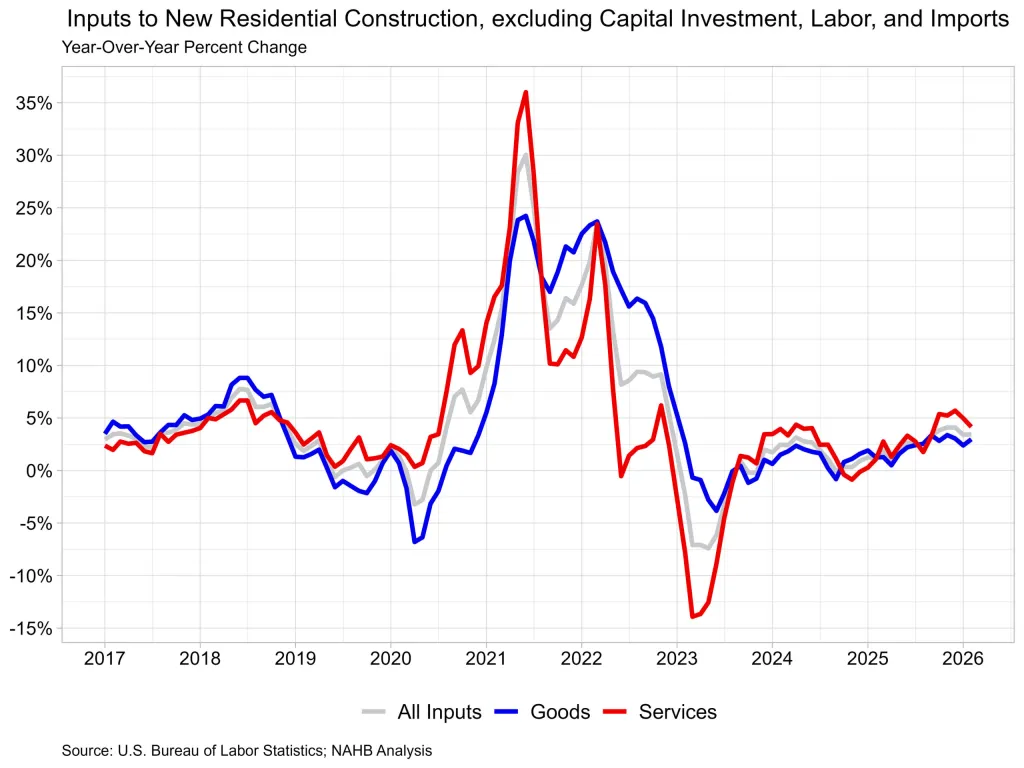
In February, the price index for new residential construction inputs increased by 0.7%, bringing it up 3.4% from the previous year.
The price of items used in new residential construction increased by 1.1% month over month and 3.0% year over year, while the price of services increased by 0.1% month over month and 4.2% year over year.
Input Goods
The products component is more important than the other variables in the residential building price index, accounting for around 60%.
In February, the price of input commodities used in new residential building increased by 1.1% month over month.
The last time this indicator grew by more than 1.0% each month was in January 2025.
The input goods for the residential construction index can be divided into two independent components, one assessing energy inputs and the other measuring leftover products.
The latter of these two components essentially indicates building materials utilized in residential construction, which account for around 93% of the goods index.
Energy input prices increased by 9.3% in February, although were 3.5% lower than a year earlier. Building material prices rose 0.6% in February, and 3.5% year on year.
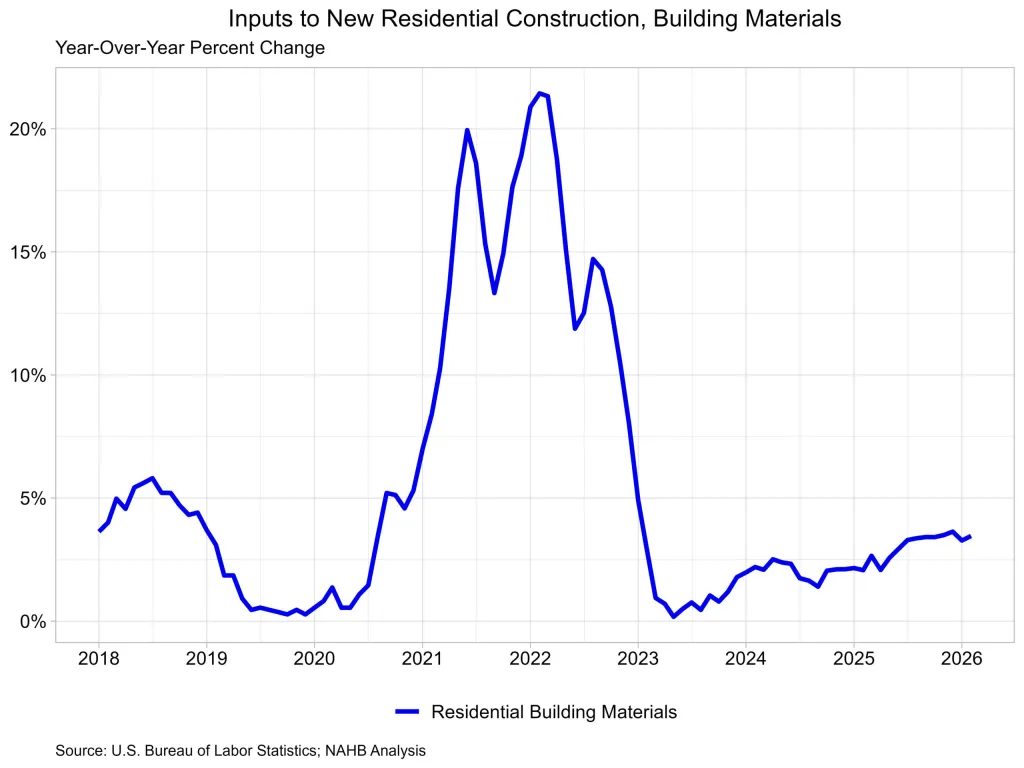
Metal items continue to have the biggest year-over-year price increases, with metal molding and trim prices up 61.7% from a year ago. Metal window prices have risen by 20.2% over the previous year.
Prices for all metals and metal products have risen 16.6% year on year. Due to the date of the study, annual price decreases were common among energy goods.
Particleboard and fiberboard prices dropped 17.4%, while softwood veneer and plywood prices fell 4.0%.
Input services
In February, prices for residential building service inputs rose by 0.1%. Year on year, service input prices rose 4.2%.
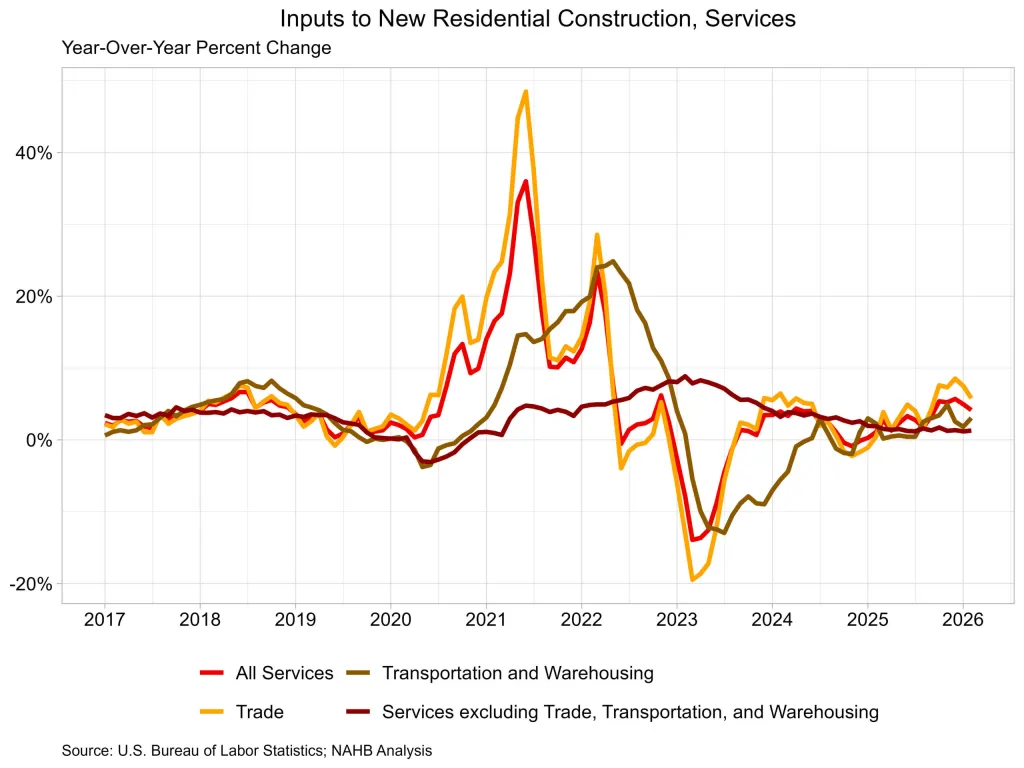
The price index for residential construction service inputs is divided into three categories: trade services, transportation and warehousing services, and services other than trade, transportation, and warehousing.
Trade services account for over 60% of the total, followed by other services (roughly 29%) and transportation and warehousing services (around 11%).
Trade services, the largest component, increased 5.8% over the previous year.
Transportation and warehousing services increased by 3.0%, while other service costs increased by 1.3% year on year.
Expanded inputs to new construction data
New experimental data on inputs for new construction was just provided in the BLS’s PPI.
The data supplemented current industry index inputs by include import prices as well as prices for domestically produced goods and services.
With this new information, consumers can monitor how industry input costs vary between domestically produced and imported items.
This data concentrates on new construction, however the whole dataset contains indices from a variety of industries, which may be viewed on the BLS website.
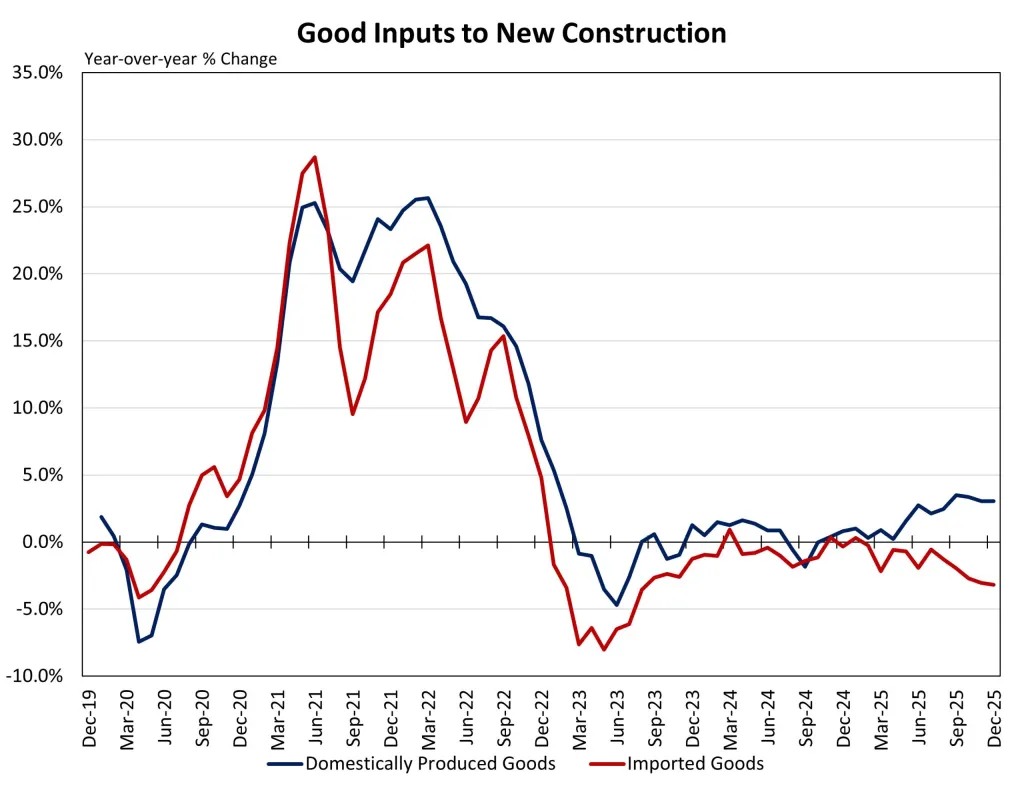
Domestically produced goods and services have the greatest influence on new construction input prices, accounting for 90% of the weight in the industry index.
Imported items comprise the remaining 10% of the index.
According to the most recent available data for December 2025, domestically produced commodities continue to increase in price when compared to imported goods utilized in new construction.
The index for local items rose 3.0% year on year, while import prices fell 3.2%.
[Read more about this topic on Eyeonhousing.org]