

March’s 0.6% monthly increase was followed by a 0.8% increase in April 2026 in private residential construction spending.
Growth in single-family and home improvement expenditures was the primary factor contributing to this increase.
Additionally, there was a 1.7% increase in the entirety of private residential construction expenditure from the previous year.
Single-family construction spending increased 1.4% in April, as indicated by the most recent construction spending data from the U.S. Census.
This increase is consistent with the consistent builder confidence observed in the NAHB/Wells Fargo Housing Market Index (HMI).
The monthly increase was not enough to offset the 2.9% decrease in single-family construction spending from the previous year.
There was also a 0.4% increase in improvement spending (remodeling) during April.
On an annual basis, remodeling continued to be a bright point, with a 7.5% increase in spending from April 2025.
Furthermore, the expenditure on multifamily construction declined by 0.3% in April.
Following two consecutive months of modest gains, this represents the first monthly decline. 1.1% more than the previous year, multifamily spending increased.
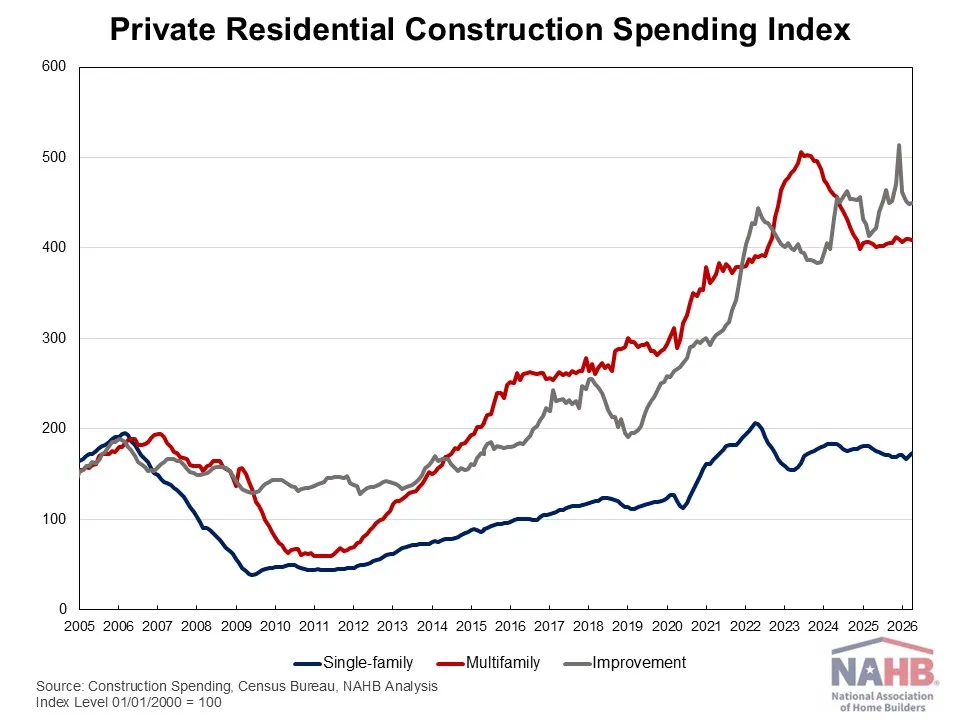
Below is the graph that displays the NAHB construction expenditure index.
Since early 2024, the index has demonstrated a decrease in spending on single-family construction, which is indicative of the ongoing uncertainty surrounding building material tariffs and elevated interest rates.
Since late 2024, the index has essentially plateaued, and multifamily construction spending growth has also slowed down following the peak in July 2023.
On the other hand, improvement expenditure has been increasing since the beginning of 2025, which is partially due to the aging housing stock and the persistent popularity of renovations.
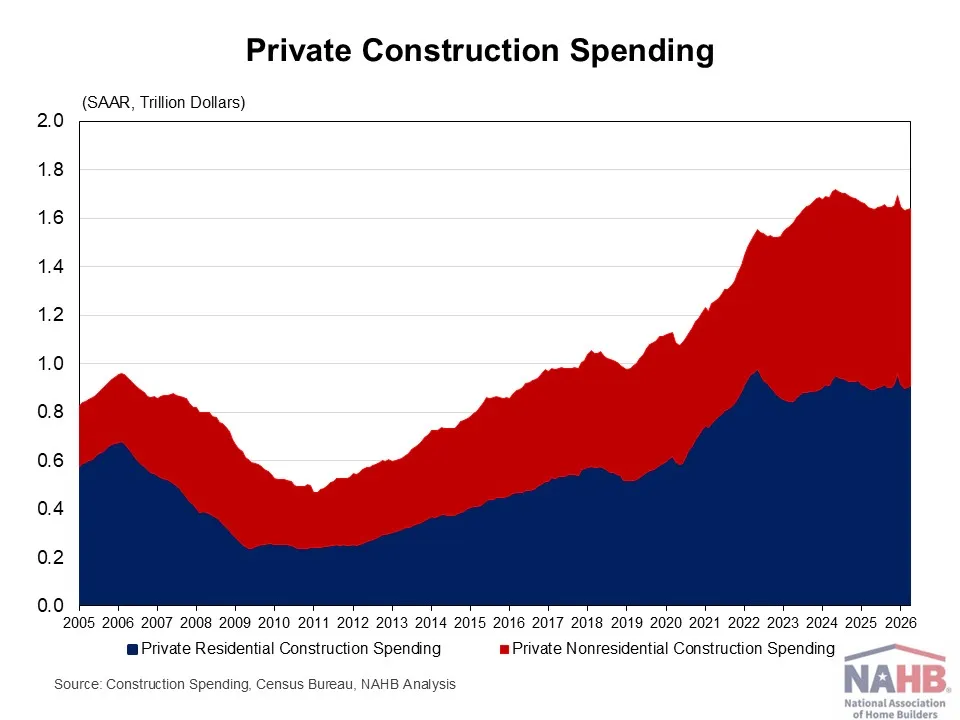
Over the previous year, there was a 2.1% decrease in the amount of money utilized for private nonresidential construction.
This year’s decrease in private nonresidential expenditure was primarily due to a $41.8 billion decrease in manufacturing construction spending.
[Read more about this topic on Eyeonhousing.org]