

According to an analysis of data published today by the U.S. Census Bureau by the Associated Builders and Contractors, total nonresidential construction expenditure remained virtually unchanged in January.
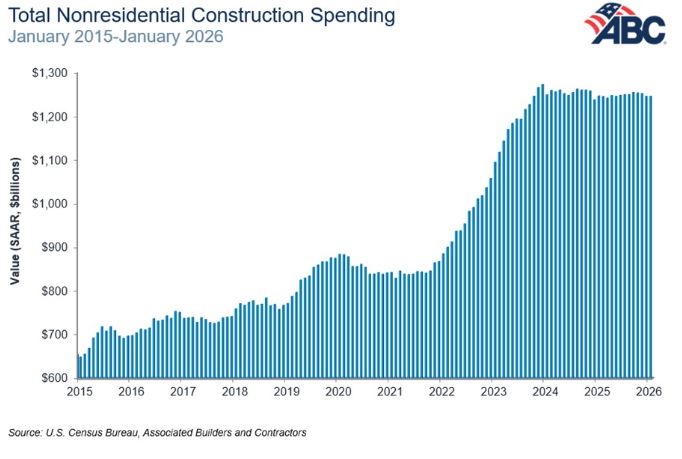
Nonresidential expenditure amounted to $1.245 trillion on an annualized basis, adjusted for seasonality.
In 9 of the 16 nonresidential subcategories, spending decreased on a monthly basis.
In January, private nonresidential expenditure decreased by 0.4%, while public nonresidential construction spending increased by 0.6%.
“Private nonresidential construction spending contracted for the fourth consecutive month in January and is currently 8% lower than the all-time high reached in December 2023,” stated ABC Chief Economist Anirban Basu.
“The ongoing decline in computer/electronic manufacturing construction is the primary concern, although harsh winter weather is likely to be a contributing factor.”
Spending in that subcategory has decreased by nearly 40% over the past 18 months as megaprojects that were incentivized by the CHIPS Act have concluded.
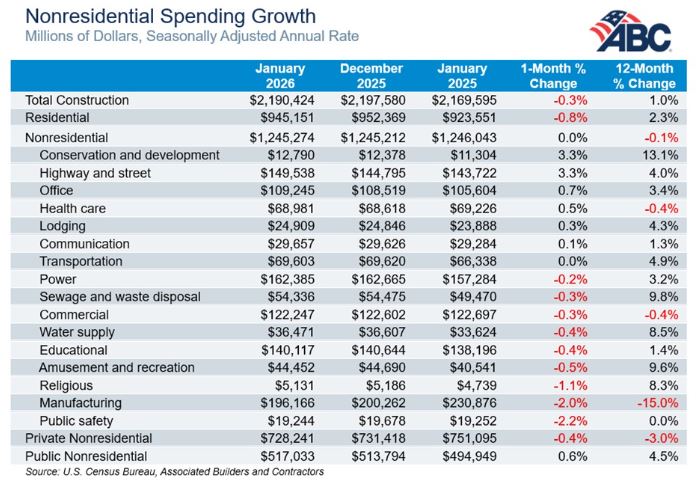
According to Basu, there are few sources of momentum to counteract the precipitous decline in manufacturing construction activity, with the exception of data centers, which experienced an additional 2% increase in expenditure during January.
“This subpar performance is particularly alarming in light of the ongoing conflict in Iran, which will exacerbate the already high levels of economic uncertainty and ignite an escalation in materials prices.”
Although ABC’s Construction Backlog Indicator experienced a modest rebound in February, increasing by 0.1 months from January’s four-year low, the first half of 2026 may be challenging for numerous contractors.
[Read more about this topic on abc.org]