

Energy input prices experienced their most significant increase since June 2020, as the conflict in Iran disrupted critical global supply chains.
Prices of building materials, with the exception of energy, increased for the eleventh consecutive month in March.
The price growth of commerce services experienced a decline, whereas transportation and warehousing prices experienced an increase.
In March, the Producer Price Index for final demand increased by 0.5%, following a 0.5% increase in February.
In March, the index for final demand services remained unaltered, while the index for final demand products increased by 1.6% during the month.
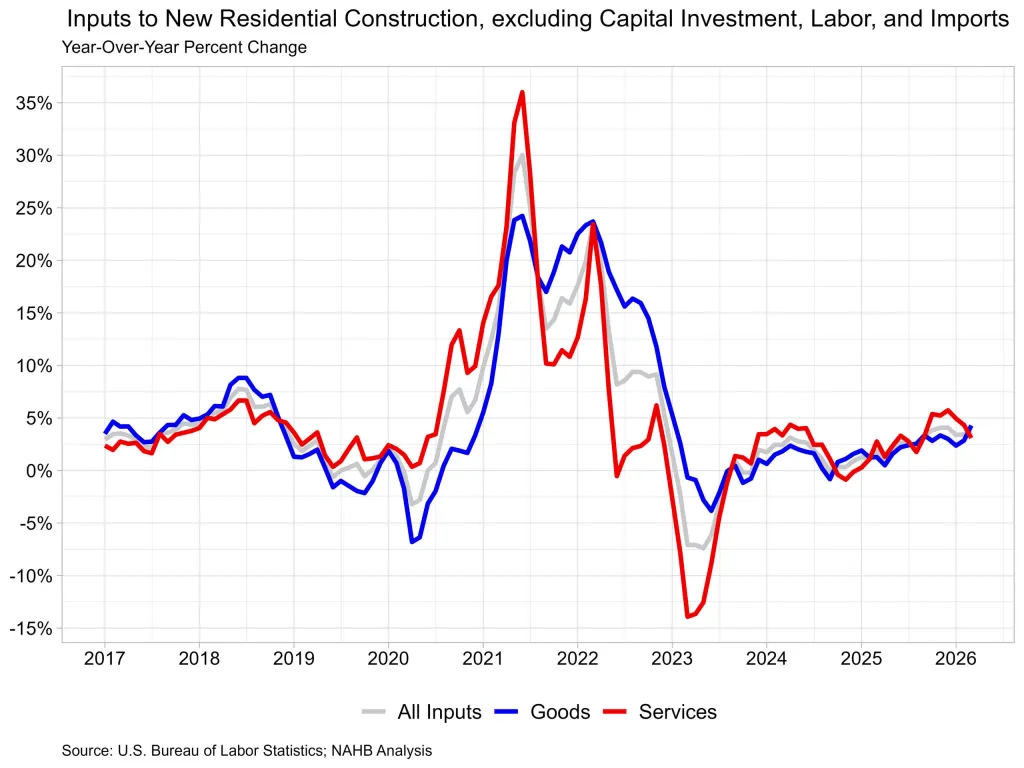
In March, the price index for inputs to new residential construction increased by 1.2%, and it was up 3.8% from the previous year.
The price of commodities used in new residential construction increased by 1.8% over the month and by 4.3% from the previous year.
Conversely, the price of services increased by 0.3% over the month and by 3.1% from the previous year.
Input Goods
The goods component is more significant than the inputs to the residential construction price index, accounting for approximately 60% of the total.
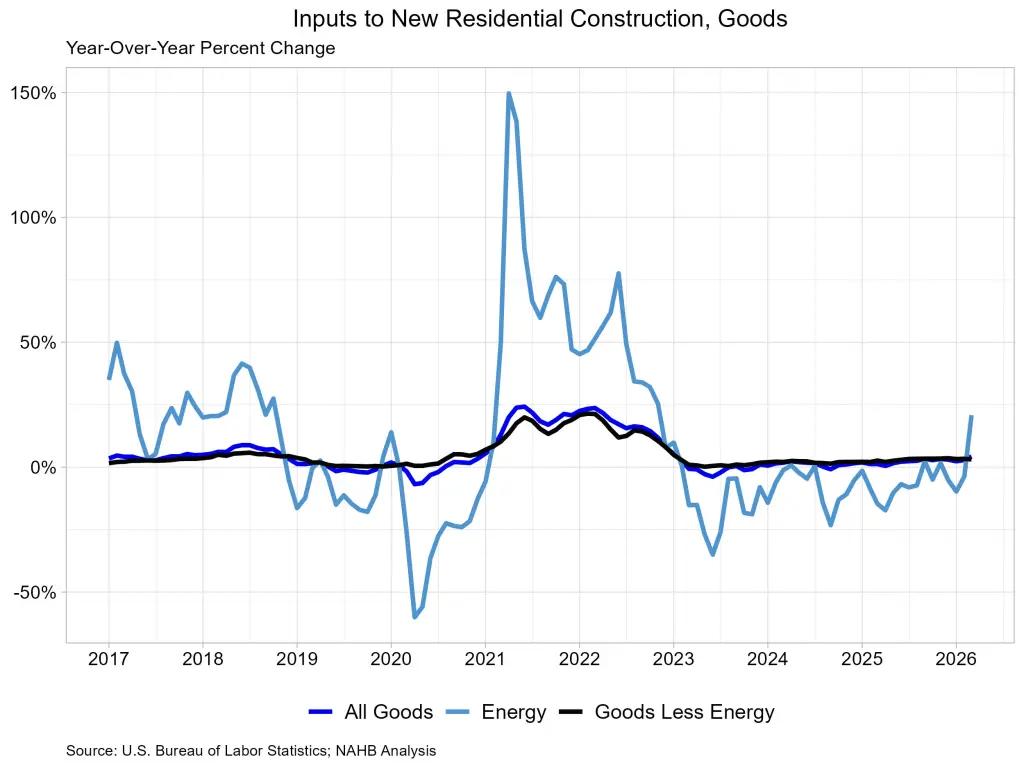
In March, the cost of input products for new residential construction increased by 1.8% on a monthly basis.
The input goods to the residential construction index can be further deconstructed into two distinct components: one that measures energy inputs and the other that measures remaining goods.
The building materials utilized in residential construction are represented by the latter of these two components, which accounts for approximately 93% of the goods index.
In March, energy input prices increased by 21.4% and were 20.8% higher than they were one year prior.
The monthly increase in March was the most substantial since June 2020, when prices increased by 30.6%.
In March, the cost of building materials increased by 0.4%, and they have increased by 3.1% in comparison to the previous year.
The No. 2 diesel fuel had the most significant year-over-year increase among input products, with prices that were 51.2% higher than they were a year ago.
The price of metal molding and ornamentation remained elevated, with a 45.5% increase from the previous year.
Conversely, particleboard and fiberboard experienced the most significant annual price decreases, with prices plummeting by 15.7%.
Asphalt experienced a 12.3% decrease in price in March. Ready-mix concrete prices were 0.5% higher than they were a year ago, while softwood lumber prices were 7.8% lower. These are the main inputs.
Input Services
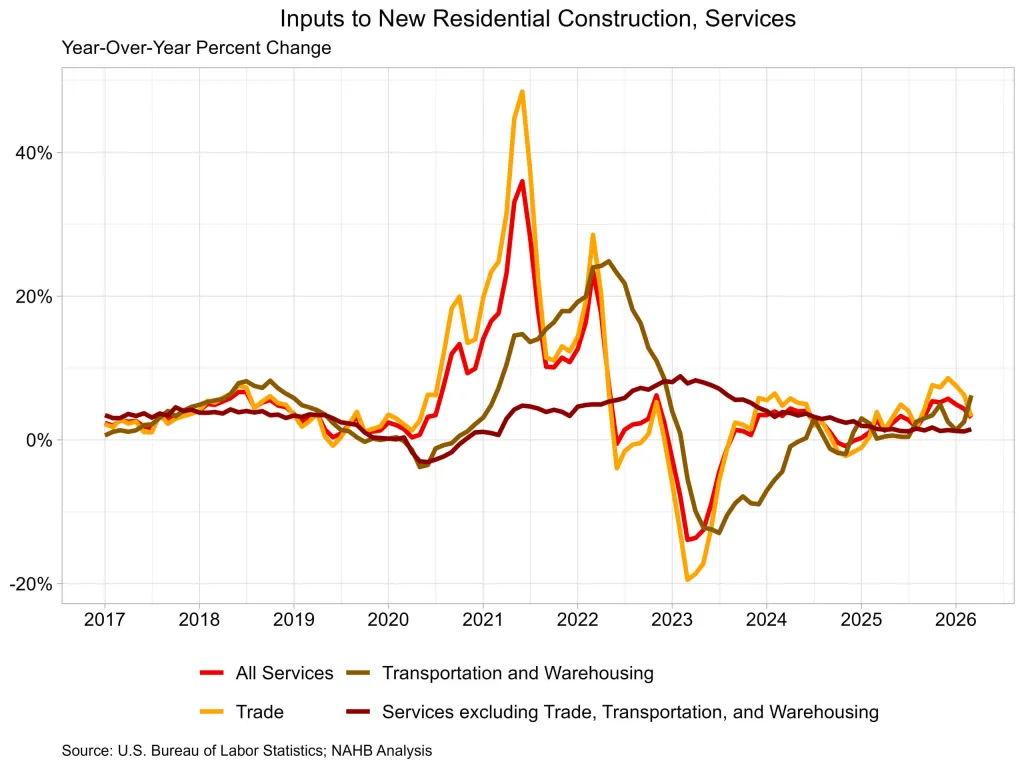
In March, there was a 0.3% increase in the price of service inputs for residential construction. Service input prices increased by 3.1% on a year-over-year basis.
The price index for service inputs to residential construction can be deconstructed into three distinct components: a trade services component, a transportation and warehousing services component, and a services excluding trade, transportation, and warehousing component (other services).
The most significant component is trade services, which account for approximately 60% of the total.
Other services represent approximately 29% of the total, and transportation and warehousing services account for approximately 11%.
Trade services, the most significant component, experienced a 3.3% increase from the previous year.
The cost of transportation and warehousing services increased by 6.2%, while the cost of other services increased by 1.5% over the course of the year.
Expanded Inputs to New Construction Data
New experimental data concerning inputs to new construction was recently published in the PPI that BLS publishes.
By integrating import prices with prices for domestically produced products and services, the data broadens the scope of existing inputs to industry indexes.
Users can monitor the fluctuations in industry input costs between domestically produced and imported products by utilizing this supplementary data.
This data concentrates on new construction; however, the comprehensive dataset encompasses indices from a variety of industries and can be accessed on the BLS website.
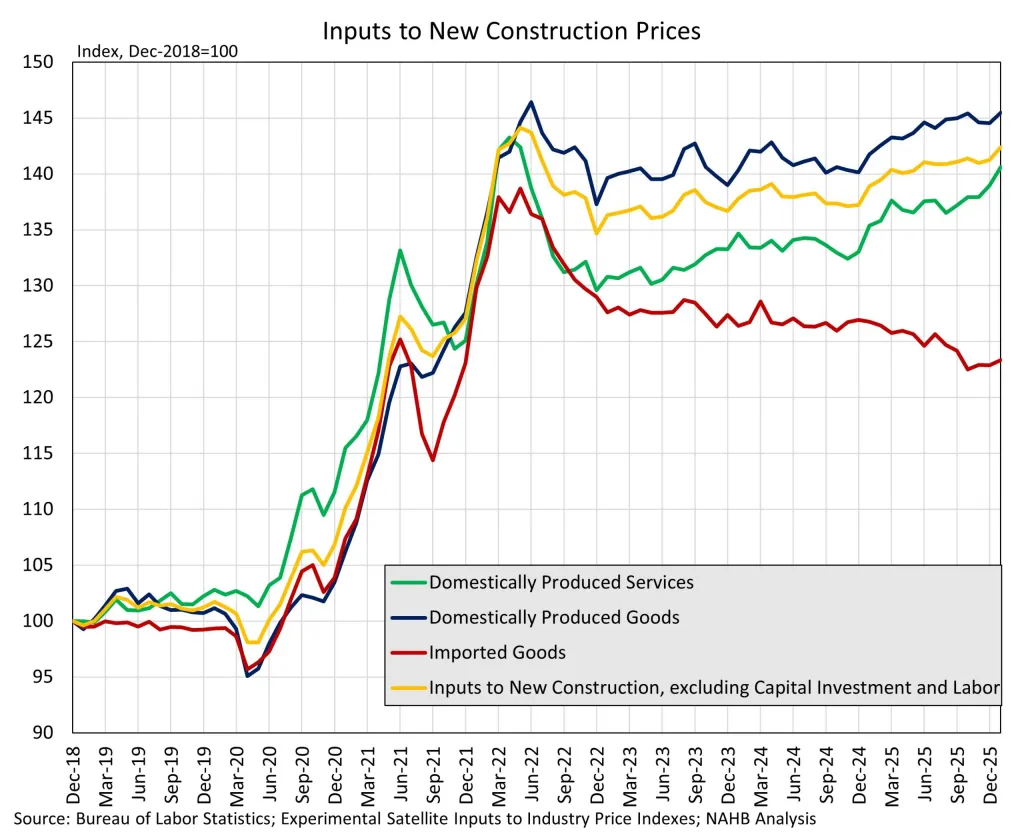
Domestically produced commodities and services are the primary factors that influence the prices of new construction inputs, with domestic products comprising 90% of the industry index for new construction.
The remaining 10% of the index is comprised of imported products.
The most recent data, which was collected in January 2026, indicated that the prices of domestically produced products are increasing in comparison to those that are imported for use in new construction.
There was a 2.6% increase in the index for domestic goods year over year, while the prices of imported products decreased by 2.7%.
[Read more about this topic on Eyeonhousing.org]